Mục lục bài viết (8)
- How does RFID work in fashion retail?
- Why does fashion inventory only achieve 65-70% accuracy with manual methods?
- Specific benefits of RFID for fashion retail chains
- Comparison: Barcode vs. RFID for Fashion Retail
- Case study: Abercrombie & Fitch and Boggi Milano achieve 99% inventory accuracy
- RFID Investment Costs for Fashion Chains in Vietnam
- RFID Implementation Roadmap for Vietnamese Fashion Businesses
- Frequently Asked Questions about RFID for Fashion Retail
RFID for fashion retail is a solution that uses UHF RFID tags attached to each product, combined with fixed and mobile readers, to automatically identify and inventory stock in real-time. Global fashion chains like Abercrombie & Fitch and Boggi Milano have achieved 99% inventory accuracy with this technology, reducing shrinkage by 30-50% and increasing omnichannel revenue by 8-15%.
How does RFID work in fashion retail?
A UHF RFID system in retail includes RFID tags attached to each product, fixed readers at entrances/checkout counters, and mobile readers for inventory checks. When radio waves scan an area, tags respond with a signal containing a unique EPC code, allowing the system to precisely identify each product without scanning them individually.
Basic operational process: When goods from the factory are tagged with RFID, information is recorded into the management system. When a shipment enters the warehouse, fixed RFID gates automatically count all products in 3-5 seconds. When products are placed on display shelves, staff use mobile readers to scan shelves in 15-30 seconds instead of 15-20 minutes with barcodes. When a customer purchases, the tag is deactivated at the POS. If an unpaid product is taken out, the RFID gate issues an alert.
Why does fashion inventory only achieve 65-70% accuracy with manual methods?
Manual inventory methods and traditional barcodes lead to inventory discrepancies due to data entry errors, shrinkage, delayed updates for returns, and difficulty in rapid counting. In a fashion retail environment with thousands of SKUs, scanning each barcode takes 15-30 minutes per shelf, resulting in low inventory check frequency and only 65-70% accuracy.
Bạn đang tìm sản phẩm cho chủ đề này?
Việt POS phân phối chính hãng — bảo hành 24-36 tháng, hỗ trợ kỹ thuật 24/7.
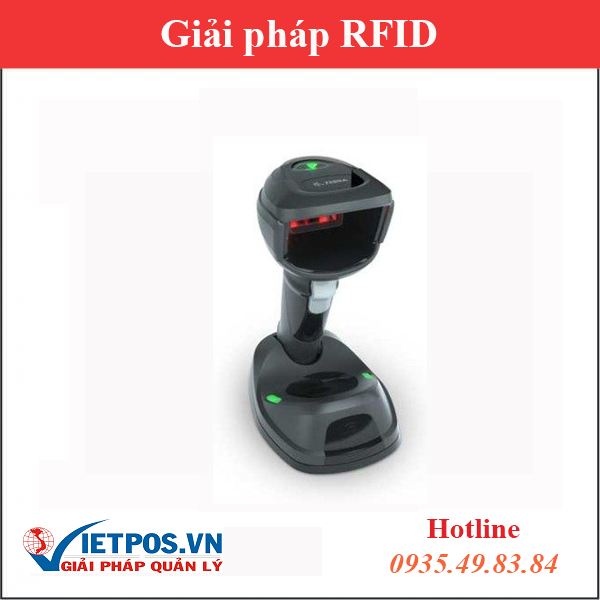
DS9900 handheld RFID reader for retail
SKU: DS9900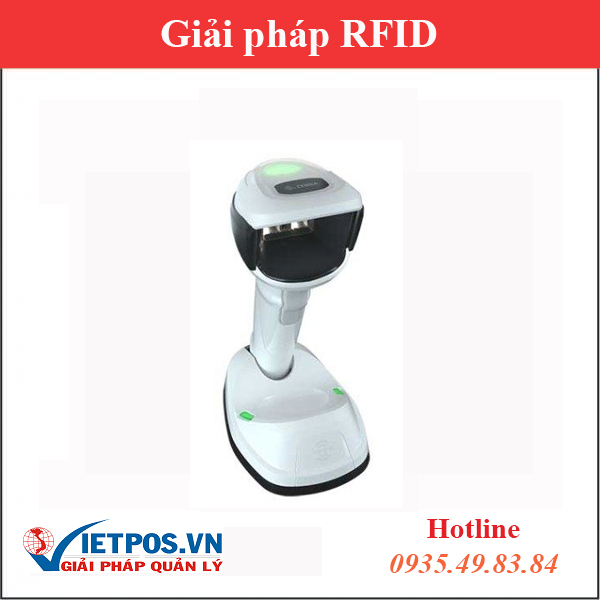
DS9900 Handheld RFID Reader for Laboratory
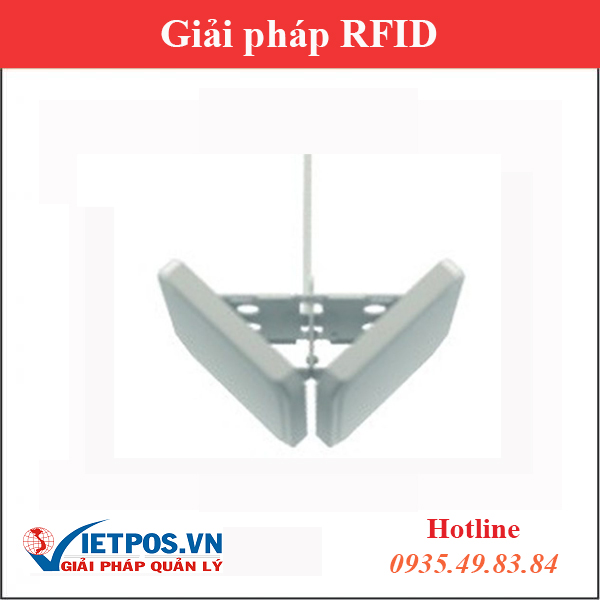
Zebra SR5502 RFID Antenna for Backroom and Warehouse
SKU: SR5502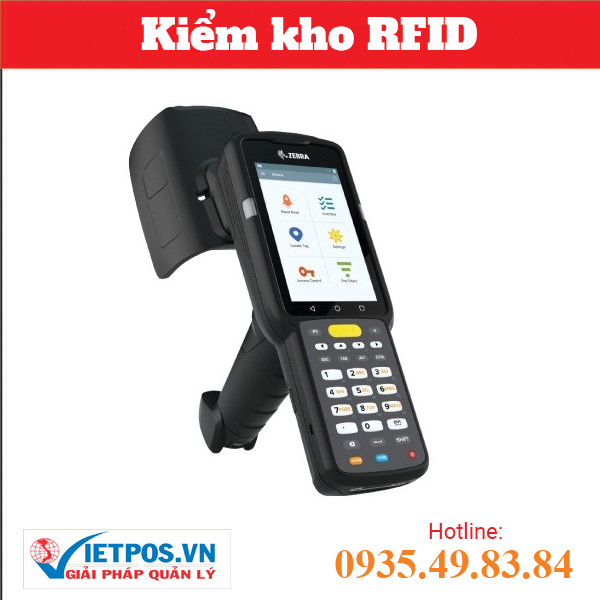
Zebra MC3390XR - RFID Inventory
- Shrinkage: Fashion chains lose 1.5-2.5% of revenue due to theft, damage, and loss. With a monthly revenue of 10 billion VND, this figure is 150-250 million VND.
- Phantom inventory: The system reports 5 shirts in stock, but only 2 are actually available, leading to lost online orders and an 8-15% reduction in omnichannel revenue.
- Labor costs: Each full store inventory check for a 200m² store requires 3-4 employees working 4-6 hours, equivalent to 1.5-2.5 million VND in labor costs.
Specific benefits of RFID for fashion retail chains
UHF RFID offers 4 main benefits: increasing inventory accuracy to 98-99%, reducing inventory check time by 80-90%, preventing shrinkage through smart EAS gates, and synchronizing real-time inventory between POS, websites, and e-commerce platforms.
99% Inventory Accuracy
According to data from Zebra Technologies, fashion chains implementing RFID achieve an average inventory accuracy of 98-99%, compared to 65-70% when using barcodes. For a store with 5000 SKUs, discrepancies decrease from 1500-1750 products to 50-100 products.
10-20x Faster Inventory Checks
For a 300m² store with 2000 products: manual inventory takes 4-6 hours, while inventory using a mobile RFID reader takes 15-30 minutes. For a chain of 20 stores, this saves 70-100 labor hours per month.
Smart Shrinkage Prevention
RFID gates at entrances not only alert when unpaid products are taken out, but also record the time, product, and on-duty staff. This data helps identify process weaknesses, reducing shrinkage by 30-50%.
Real-time Omnichannel Synchronization
When customers purchase online, the system checks actual inventory via RFID, confirming product availability at the nearest store. When customers pick up, the RFID tag is deactivated at the POS, updating both online and offline inventory in 1-2 seconds.
Comparison: Barcode vs. RFID for Fashion Retail
The comparison table below shows clear differences between the two technologies in terms of speed, accuracy, and scalability for fashion retail chains.
| Criterion | Barcode | RFID UHF |
|---|---|---|
| Inventory check time for 500 products | 15-25 minutes | 15-30 seconds |
| Inventory accuracy | 65-75% | 98-99% |
| Simultaneous reading capability | 1 product/time | 200-500 products/time |
| Real-time shrinkage detection | No | Yes (RFID gate) |
| Omnichannel synchronization | Manual, slow | Automatic, real-time |
| Initial investment cost | Low (5-10 million VND) | Medium-high (50-300 million VND) |
| Monthly operating cost (20 stores) | 15-25 million VND (labor) | 5-8 million VND (maintenance + tags) |
Case study: Abercrombie & Fitch and Boggi Milano achieve 99% inventory accuracy
Two global fashion brands have demonstrated RFID's effectiveness: Abercrombie & Fitch implemented it across 700 stores, achieving 99% accuracy and reducing shrinkage by 40%; Boggi Milano applied Zebra Technologies' solution, increasing omnichannel revenue by 12% thanks to real-time inventory.
Abercrombie & Fitch began RFID implementation in 2020, tagging 100% of products. Results after 18 months: inventory accuracy increased from 68% to 99%, online revenue from stores (click-and-collect) increased by 25%, and shrinkage decreased by 40%. Investment costs for each store were approximately 15,000-25,000 USD, with ROI within 12-18 months.
Boggi Milano, an Italian men's fashion brand, partnered with Zebra Technologies to deploy RFID in 180 stores. They achieved 99% inventory accuracy, reduced inventory check time by 50%, and increased omnichannel revenue by 12% due to the ability to sell from actual store inventory via online channels.
RFID Investment Costs for Fashion Chains in Vietnam
RFID deployment costs depend on scale: for a 10-store chain, each store 300m², total investment is approximately 200-400 million VND, including RFID tags, mobile readers, fixed gates, and software integration. ROI period is 12-18 months.
- UHF RFID tags: 1,500-3,500 VND/tag (for bulk purchases of 50,000+ tags). For a store with 5000 products, tag cost is 7.5-17.5 million VND.
- Mobile readers (handheld): 15-30 million VND/device (Zebra MC3300, Honeywell CK65). 2-3 devices/store needed.
- Fixed RFID gates: 30-50 million VND/pair (transmitter + antenna). 1-2 pairs/store needed.
- POS software integration: 20-50 million VND for the entire chain (depending on customization level).
- Monthly maintenance cost: 2-5 million VND for 10 stores (battery replacement, repairs, software updates).
RFID Implementation Roadmap for Vietnamese Fashion Businesses
The RFID implementation roadmap typically lasts 3-6 months, divided into 4 phases: current state assessment, pilot testing at 1-2 stores, full chain expansion, and operational optimization.
Phase 1 (1-2 months): Assess current processes, select 1-2 representative stores (high revenue, many SKUs, central location). Equipment selection: Zebra or Honeywell readers are recommended for high reliability, UHF RFID tags from suppliers like Confidex or Avery Dennison.
Phase 2 (1-2 months): Tag 100% of products at the pilot store. Install RFID gates at entrances and POS counters. Staff training (2-3 sessions, 2 hours each). Operate in parallel with the old process for 2-4 weeks to compare data.
Phase 3 (1-2 months): Expand to the entire chain. Integrate RFID data with the current POS software (Việt POS supports API integration with RFID systems). Establish daily inventory check procedures using mobile readers (15 minutes/store).
Phase 4: Data-driven optimization: adjust minimum stock levels, automatically suggest replenishment, analyze customer behavior based on most-tried products.
Frequently Asked Questions about RFID for Fashion Retail
Does RFID completely replace barcodes?
Not entirely. Many fashion chains still keep barcodes on hang tags for backup and compatibility with logistics partners without RFID. However, the main process shifts to RFID, with barcodes serving as a backup. The 2025-2026 trend is to print barcodes and RFID on the same tag (dual-technology tag).
Is the RFID investment cost too high for a 5-10 store chain?
For a 5-store chain, the total investment is approximately 100-200 million VND, equivalent to 20-40 million VND/store. If each store reduces shrinkage by 1.5-2.5% (equivalent to 3-8 million VND/month with 200-500 million VND revenue), the ROI period is 12-18 months. Additionally, labor costs for inventory checks save 5-10 million VND/month.
Do RFID tags affect the shopping experience?
Modern UHF RFID tags are small (30x15mm) and can be embedded in hang tags or seams. Customers do not perceive any difference. Some high-end brands use detachable RFID tags at the counter to enhance the experience. In Vietnam, chains like Canifa and Blue Exchange have tested and received positive feedback.
How to integrate RFID with current POS?
Most modern POS software supports API connection with RFID systems. Việt POS provides an RFID integration module, allowing synchronization of tag data with products, automatic inventory updates upon scanning, and discrepancy reporting. Integration time is 2-4 weeks depending on the level of customization.
Does RFID help detect counterfeit goods?
Yes. Each UHF RFID tag has a unique EPC code that cannot be easily copied. Combined with blockchain, businesses can authenticate product origin from the factory to the customer. Some luxury fashion brands have implemented this solution to combat counterfeiting.
How often should RFID inventory checks be performed?
With mobile readers, a full store inventory check takes 15-30 minutes, so it can be done daily or weekly. Optimized chains often perform daily checks at the beginning (15 minutes) and end (15 minutes) of shifts to detect discrepancies promptly. A full chain inventory check is done once a month.
Which RFID readers are suitable for fashion stores in Vietnam?
Popular reader models include: Zebra MC3300 (15-25 million VND, high durability, 8-10 hour battery), Honeywell CK65 (18-28 million VND, touchscreen, IP65 water resistance), or more affordable models like iData J20 (8-12 million VND). It is advisable to choose readers that support both RFID and barcodes for flexibility. Việt POS provides consultation to select suitable equipment based on scale and budget.
For consultation on RFID solutions for your fashion retail chain, contact Việt POS immediately via hotline 0935 498 384 or email info@vietpos.vn. We support current state assessment, equipment recommendations, and integration with existing POS systems.
Cần tư vấn thiết bị/giải pháp cụ thể?
Việt POS phản hồi trong 30 phút · Hotline 4 vùng · Khảo sát miễn phí.
Bài viết cùng chủ đề