Mục lục bài viết (8)
- What is RFID UHF and why is it suitable for warehouse inventory?
- Barcode vs. RFID UHF Inventory Comparison: Specific Data
- Specific Benefits of RFID UHF in Warehouse Inventory
- RFID UHF System Structure for Vietnamese Warehouses
- Costs and ROI of RFID UHF Warehouse Inventory Implementation
- Case Study: Vietnamese Retail Chain Reduces Inventory Time by 80% with RFID UHF
- RFID UHF Implementation Roadmap for Vietnamese Businesses 2026
- Frequently Asked Questions about RFID UHF Inventory
RFID UHF (Ultra High Frequency Radio Frequency Identification) technology allows simultaneous reading of 300-500 tags/second from a distance of 3-10 meters without scanning each barcode. Applying RFID UHF in warehouse inventory helps Vietnamese businesses reduce inventory time from 2-3 days to 2-3 hours, achieving 99.8% accuracy and reducing errors by 90% compared to manual methods.
What is RFID UHF and why is it suitable for warehouse inventory?
RFID UHF is a radio frequency identification technology operating in the 860-960 MHz band, designed for high-speed, long-range tag reading (3-10 meters). Unlike low-frequency (LF) or high-frequency (HF) RFID, UHF is optimized for warehouse environments due to its bulk reading capability and wide coverage area.
A basic RFID UHF system consists of three components: RFID tags attached to pallets/boxes (containing a 96-bit EPC code), RFID readers (fixed reader or handheld terminal), and management software for data processing. When the reader emits radio waves, tags within the coverage area respond with their unique identifiers — this process occurs within 10-30 milliseconds per tag, allowing 500-700 tags/second to be read depending on configuration.
Barcode vs. RFID UHF Inventory Comparison: Specific Data
The table below directly compares traditional barcode inventory methods with RFID UHF based on actual operational metrics at a 2000m² Vietnamese warehouse with 10,000 SKUs.
Bạn đang tìm sản phẩm cho chủ đề này?
Việt POS phân phối chính hãng — bảo hành 24-36 tháng, hỗ trợ kỹ thuật 24/7.
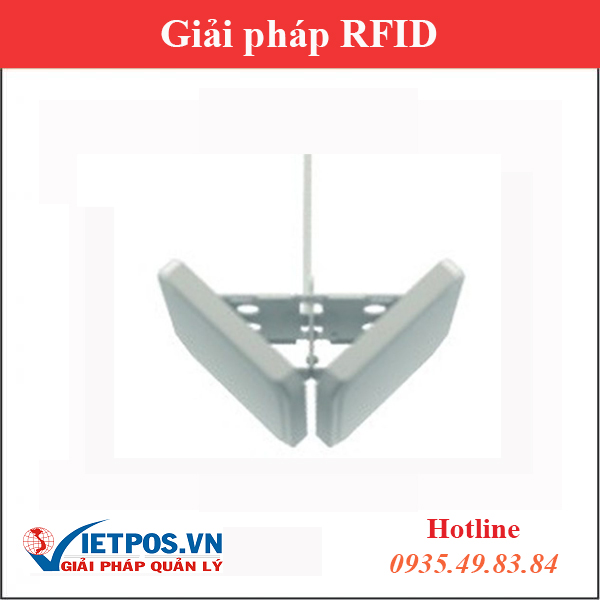
Zebra SR5502 RFID Antenna for Backroom and Warehouse
SKU: SR5502
Zebra RCH51 – Wired Headset for Inventory Scanners

Magnetic strips for books – Magnetic tags for DVDs
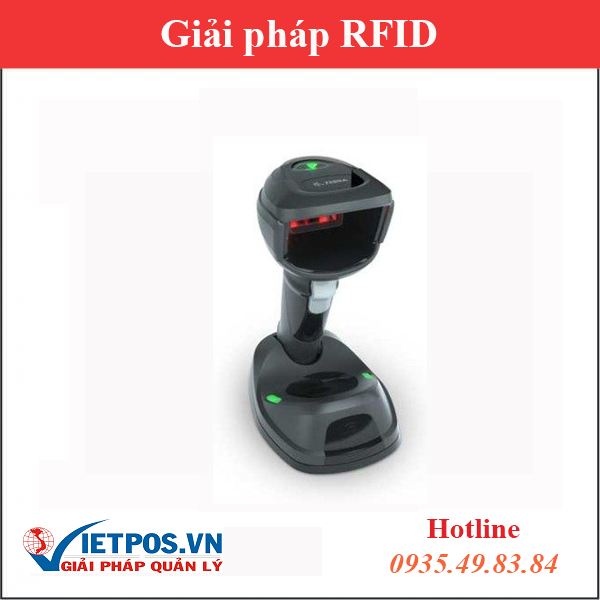
DS9900 handheld RFID reader for retail
SKU: DS9900| Criteria | Manual Barcode | RFID UHF | Improvement |
|---|---|---|---|
| Time to inventory 10,000 SKUs | 48-72 hours (2-3 days) | 4-6 hours | 8-12 times faster |
| Personnel required | 8-12 people | 1-2 people | 80% reduction |
| Error rate | 3-5% | 0.1-0.3% | 90%+ reduction |
| Simultaneous reading | 1 tag/time | 300-500 tags/second | Not comparable |
| Reading distance | 0-10 cm (contact) | 3-10 meters | 30-100 times farther |
| Initial investment cost | 5-15 million VND (printer + reader) | 50-200 million VND | 5-10 times higher |
| Annual operating cost | 80-150 million VND (inventory labor) | 15-30 million VND | 70-80% reduction |
The initial investment cost for RFID UHF is higher, but ROI is typically achieved within 8-14 months due to labor savings and reduced inventory shrinkage (usually 2-5% of inventory value).
Specific Benefits of RFID UHF in Warehouse Inventory
RFID UHF offers 5 key benefits: 8-12 times faster inventory, 90%+ error reduction, real-time inventory, 15-25% reduction in dead stock, and supply chain transparency from factory to point of sale.
8-12 Times Faster Inventory
With a reading speed of 300-500 tags/second, an employee using a handheld RFID reader can walk down an aisle and inventory an entire shelf in 5-10 minutes, instead of 1-2 hours with barcodes. A 5000 SKU warehouse can be completed in 2-3 hours instead of 2 days.
Reduced Errors and Inventory Shrinkage
Barcodes rely on manual scanning — prone to omissions, incorrect scans, or wrong quantity entries. RFID UHF automatically records all tags within its coverage, eliminating human error. Vietnamese businesses typically lose 2-5% of inventory value annually due to inventory discrepancies; RFID reduces this rate to below 0.5%.
Real-time Inventory (Cycle Counting)
Instead of full warehouse inventory quarterly/annually, RFID enables daily cycle counting of specific areas without interrupting operations. RFID gates at entry/exit points automatically record incoming/outgoing goods, updating inventory in real-time on the ERP management software.
RFID UHF System Structure for Vietnamese Warehouses
A standard RFID UHF system comprises RFID tags (attached to pallets/boxes), fixed readers (dock gates/warehouse doors) or mobile readers (handheld), UHF antennas (optimizing coverage), and middleware connecting to warehouse management software (WMS) or ERP.
RFID UHF Tags
Priced at 800-2,500 VND/piece depending on type (adhesive paper tags, hard plastic tags, heat-resistant tags). Passive tags (no battery) are most common for warehouse inventory, with a lifespan of 5-10 years. RFID UHF tags can be attached to pallets, cartons, or individual products depending on the desired inventory detail level.
Handheld RFID Readers
Priced at 12-45 million VND depending on brand and features (Zebra, Honeywell, iData). These Android-powered devices integrate cameras, 4G, WiFi, support reading 500+ tags/second, and have a range of 5-10 meters. Battery life is 8-12 continuous hours. Suitable for mobile inventory and goods receiving/shipping.
RFID Gates (Fixed Reader + Antenna)
Placed at warehouse doors, conveyor belts, or receiving docks. Automatically reads tags as pallets pass through, recording quantity and time in real-time. Costs 20-60 million VND/gate depending on the number of antennas and power output.
Costs and ROI of RFID UHF Warehouse Inventory Implementation
The ROI of an RFID UHF system depends on warehouse size and inventory frequency. For a 2000m² warehouse with 10,000 SKUs, total investment is 120-180 million VND, with a payback period of 10-14 months due to 80% labor savings and 2-3% reduction in inventory shrinkage.
| Warehouse Size | Initial Investment | Annual Labor Savings | Annual Shrinkage Reduction | ROI (months) |
|---|---|---|---|---|
| 500m² (3,000 SKUs) | 50-80 million VND | 60-90 million VND | 15-30 million VND | 8-12 months |
| 2000m² (10,000 SKUs) | 120-180 million VND | 120-180 million VND | 40-80 million VND | 10-14 months |
| 5000m² (30,000 SKUs) | 250-400 million VND | 250-400 million VND | 100-200 million VND | 9-13 months |
RFID tag costs account for 30-40% of the total initial investment (for 10,000 tags x 1,500 VND = 15 million VND). Handheld readers account for 20-30%, and RFID gates and antennas for 30-40%. Annual maintenance costs are approximately 5-10% of the investment value.
Case Study: Vietnamese Retail Chain Reduces Inventory Time by 80% with RFID UHF
A 15-store convenience chain (Ho Chi Minh City) with a 2000m² central warehouse and 12,000 SKUs implemented RFID UHF in Q1/2025. After 6 months, results showed inventory time reduced from 48 hours to 5 hours, inventory discrepancy decreased from 4.2% to 0.3%, saving 180 million VND/year in labor costs.
Before RFID, this chain used 3 full-time inventory staff, closing the warehouse for 2 days each month for periodic inventory. After attaching RFID UHF tags to all pallets and boxes (15,000 tags, total cost 22.5 million VND), they invested in 2 Zebra handheld readers (28 million VND/unit) and 2 RFID gates at entry/exit points (45 million VND/gate). Total investment was 140.5 million VND, with a payback period of 9.5 months. Currently, inventory is performed weekly, taking 5 hours with 1 employee, without needing to halt warehouse operations.
RFID UHF Implementation Roadmap for Vietnamese Businesses 2026
RFID UHF implementation involves 4 steps: current state assessment and ROI calculation (2-4 weeks), selecting suitable equipment and tags (1-2 weeks), tag attachment and system configuration (2-4 weeks), and staff training and pilot operation (1-2 weeks). Total time is 6-12 weeks depending on scale.
- Step 1 — Assessment and ROI Calculation: Survey SKU count, inventory frequency, current labor costs, and shrinkage rate. Calculate projected ROI with 3 scenarios (low, medium, high).
- Step 2 — Equipment and Tag Selection: Choose appropriate RFID UHF tags (adhesive paper for pallets, hard plastic for boxes, heat-resistant for food). Select handheld readers (Zebra MC3390R, Honeywell CK65, iData J20) or fixed readers (Impinj, Zebra).
- Step 3 — Tag Attachment and Configuration: Attach tags to pallets/boxes (standardized placement for optimal reading). Configure antennas, coverage area, and middleware to connect with existing warehouse management software.
- Step 4 — Training and Operation: Provide 2-3 days of training for warehouse staff on tag reading procedures, error handling, and equipment maintenance. Conduct parallel operations for 2 weeks to cross-reference data.
Frequently Asked Questions about RFID UHF Inventory
Can RFID UHF read through metal and liquids?
Standard RFID UHF tags are affected by metal and liquids as radio waves are reflected or absorbed. However, specialized tags (on-metal tags, moisture-resistant) are specifically designed for these environments. On-metal tags feature an isolating layer, priced at 3,000-8,000 VND/piece, and read stably on metal surfaces. For liquids, tags should be attached in positions not in direct contact or moisture-proof plastic-encased tags should be used.
What is the minimum RFID UHF investment cost for a small 200m² warehouse?
A 200m² warehouse with 2,000-3,000 SKUs can be implemented for 35-50 million VND: 1 Android handheld RFID reader (12-18 million VND), 3,000 adhesive paper RFID UHF tags (2,500-4,500 VND/tag, total 7.5-13.5 million VND), RFID-integrated warehouse management software (10-15 million VND), and implementation consulting fees (5-8 million VND). Fixed RFID gates are not required—only a handheld reader is used for receiving/shipping and periodic inventory. Expected ROI is 8-12 months.
Can RFID UHF integrate with existing warehouse management software (WMS)?
Yes. Most RFID UHF readers support programming interfaces (API/SDK) and the Low Level Reader Protocol (LLRP) for connection to WMS, ERP, or POS systems. RFID middleware (such as Impinj ItemSense, Zebra Savanna) acts as a bridge, processing raw data from readers and transmitting it to the management system in standard formats (XML, JSON, EDI). Integration typically takes 2-4 weeks, depending on the complexity of the existing system.
Can RFID UHF tags be reused?
Passive RFID UHF tags (without batteries) can be reused if carefully removed and not physically damaged. Their average lifespan is 5-10 years, enduring 10,000-100,000 read/write cycles. However, in practical warehouse inventory, tags are typically affixed to pallets/boxes and used until the pallet/box reaches its end-of-life (3-5 years). Given the low cost of tags (800-2,500 VND), reuse does not offer significant economic benefits compared to the labor cost of removal.
How to ensure 100% tag reading during RFID UHF inventory?
To achieve a reading rate of 99.5%+, four factors must be optimized: (1) reading distance—keep the reader 3-5 meters from shelves, at a 45-90 degree angle; (2) movement speed—walk slowly at 1-1.5 m/second; (3) antenna configuration—use circularly polarized antennas for omnidirectional reading; (4) dead zone checks—use heatmap software to identify weak signal areas. For tags on metal pallets, use on-metal tags and linearly polarized antennas. Performing inventory twice (forward and backward passes) helps achieve 99.9%.
Can RFID UHF be interfered with by other devices in the warehouse?
Potentially. The UHF band (860-960 MHz) is shared with some telecommunication and industrial equipment. Interference often comes from: electric motors, fluorescent lights, welding equipment, and other RFID readers operating on the same frequency. Solutions include: (1) using less congested frequency channels (configured in the reader); (2) installing antennas 2-3 meters away from interference sources; (3) using readers with anti-interference features (Dense Reader Mode); (4) checking the frequency spectrum with a spectrum analyzer before installation. In Vietnam, the 920-925 MHz band is licensed for RFID UHF, which is relatively clear of interference.
How long does it take to train staff to use RFID UHF?
Warehouse staff can operate basic handheld RFID readers after 2-4 hours of training. The process includes: turning on the device, selecting inventory mode, walking aisles at a standard pace, viewing results on screen, and exporting reports. Advanced training (error handling, maintenance, antenna configuration) takes 1-2 days. For staff familiar with Android devices, the learning curve is reduced by 50%. It is advisable to have 1-2 technical personnel undergo intensive training for 3-5 days to handle troubleshooting.
Are warehouse process changes needed when switching to RFID UHF?
Yes, but not extensively. Key changes include: (1) receiving process—attaching RFID tags to pallets/boxes upon arrival (adds 2-5 minutes/pallet); (2) inventory—transitioning from scanning individual barcodes to walking with a reader; (3) shipping—RFID gates automatically record items, eliminating manual scanning. Other processes (warehouse organization, ordering, returns) remain largely unchanged. The transition period is 2-4 weeks for staff adaptation. It is recommended to run barcode and RFID systems in parallel for 1-2 months to cross-reference data.
Contact Việt POS for consultation on RFID UHF solutions tailored to your warehouse size. Call now 0935 498 384 or email info@vietpos.vn — our technical team offers free site surveys and detailed ROI calculations.
Cần tư vấn thiết bị/giải pháp cụ thể?
Việt POS phản hồi trong 30 phút · Hotline 4 vùng · Khảo sát miễn phí.
Bài viết cùng chủ đề