Table of contents (8)
- What is an EAS gate and how does it work?
- What is a store RFID gate and how does it differ from an EAS gate?
- Comparison table of EAS anti-theft gates and RFID gates by operational criteria
- Combined RFID + EAS gate: an option for stores that want to migrate gradually
- When is an EAS anti-theft gate enough?
- Common mistakes when choosing and installing security gates
- Which gate to choose for your store: a 4-step process
- Frequently asked questions

An EAS (Electronic Article Surveillance) gate is a security device that detects tags that have not been deactivated when passing through the door. An RFID gate is a device that reads the code of each item via UHF waves, cross-checks it against the list of paid transactions, and stores the event history by gate and by time. The two technologies solve two different problems: EAS answers the question "is someone taking an unpaid item outside", RFID answers the question "which item, what code, through which gate, at what time, has it been paid for". This article compares the two types from an operational perspective so store owners can choose correctly.
An EAS gate only detects an active tag passing through; it does not know which item it is. An RFID gate reads the code of each item, cross-checks it against paid items, and records the gate and the time. Stores with low-value goods that do not yet need stocktaking can do with EAS. Fashion stores, cosmetics stores, and chains with many SKUs should choose RFID gates or combined RFID + EAS gates to migrate gradually.
Table of contents
- What is an EAS gate and how does it work?
- What is a store RFID gate and how does it differ from an EAS gate?
- Comparison table of EAS gates and RFID gates by operational criteria
- Combined RFID + EAS gates: the choice for stores that want to migrate gradually
- When is an EAS gate alone enough?
- Common mistakes when choosing and installing security gates
- Which gate to choose for your store: a 4-step process
- Frequently asked questions
What is an EAS gate and how does it work?
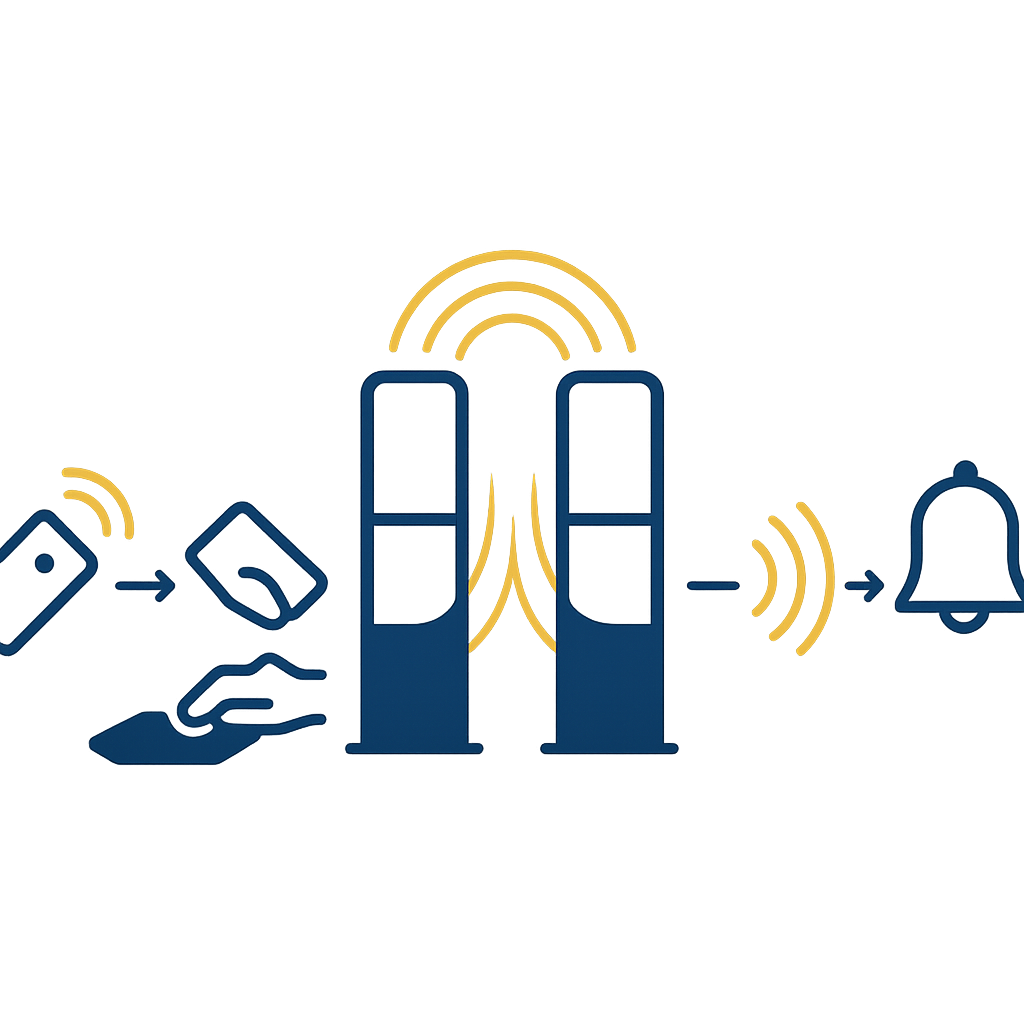
An EAS gate is a system consisting of two antenna panels placed on either side of the exit, emitting an electromagnetic field at a fixed frequency. Each item is fitted with a hard magnetic tag or a soft magnetic label. When the cashier processes payment, the tag is removed or magnetically deactivated with a deactivator. If an active tag passes through the gate, the electromagnetic field is disturbed and the gate triggers an alarm. An EAS gate only knows that an active tag has passed through; it does not know which item it is.
There are two common EAS families on the market: radio-frequency EAS (RF) and magnetic EAS (AM). The Sensormatic Synergy 2.5 Acrylic Pedestal gate is an example of the EAS RF line using transparent acrylic panels, with a detection performance of 2.5 m per the manufacturer's specifications and an integrated people-counting sensor. For fashion, cosmetics, and accessories stores, EAS is a familiar security layer because hard tags can be easily attached to handbags, jackets, and cosmetics boxes and tag costs are low.
- Advantages: cheap tags, fast installation, staff are familiar with the operation, suitable for medium- and low-value goods.
- Limitations: binary alarm only, no item data, cannot distinguish paid from unpaid goods if the tag has not been deactivated, not shared for stocktaking.
See the deployment approach, devices, and phased roadmap on the loss prevention solution using RFID + EAS gates page.
What is a store RFID gate and how does it differ from an EAS gate?
Related products


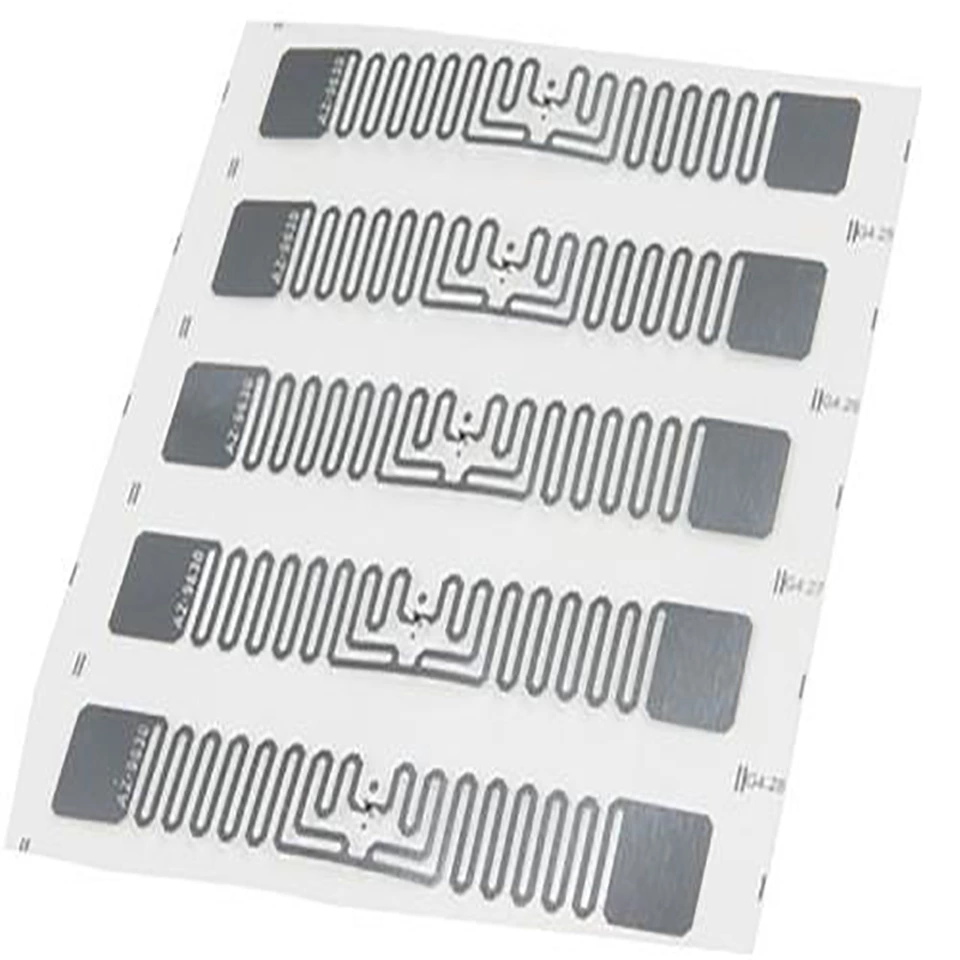
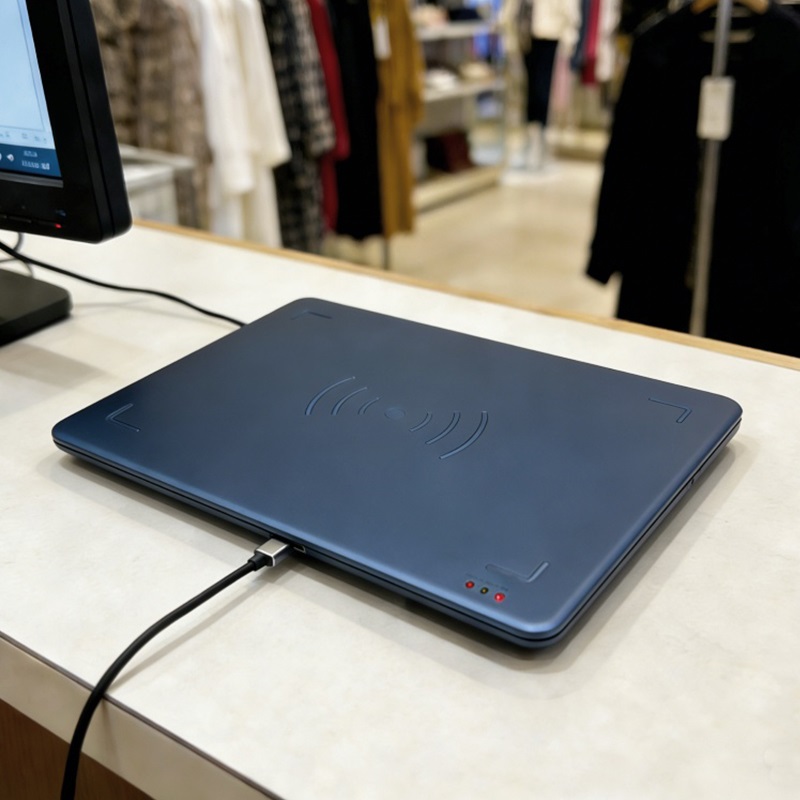
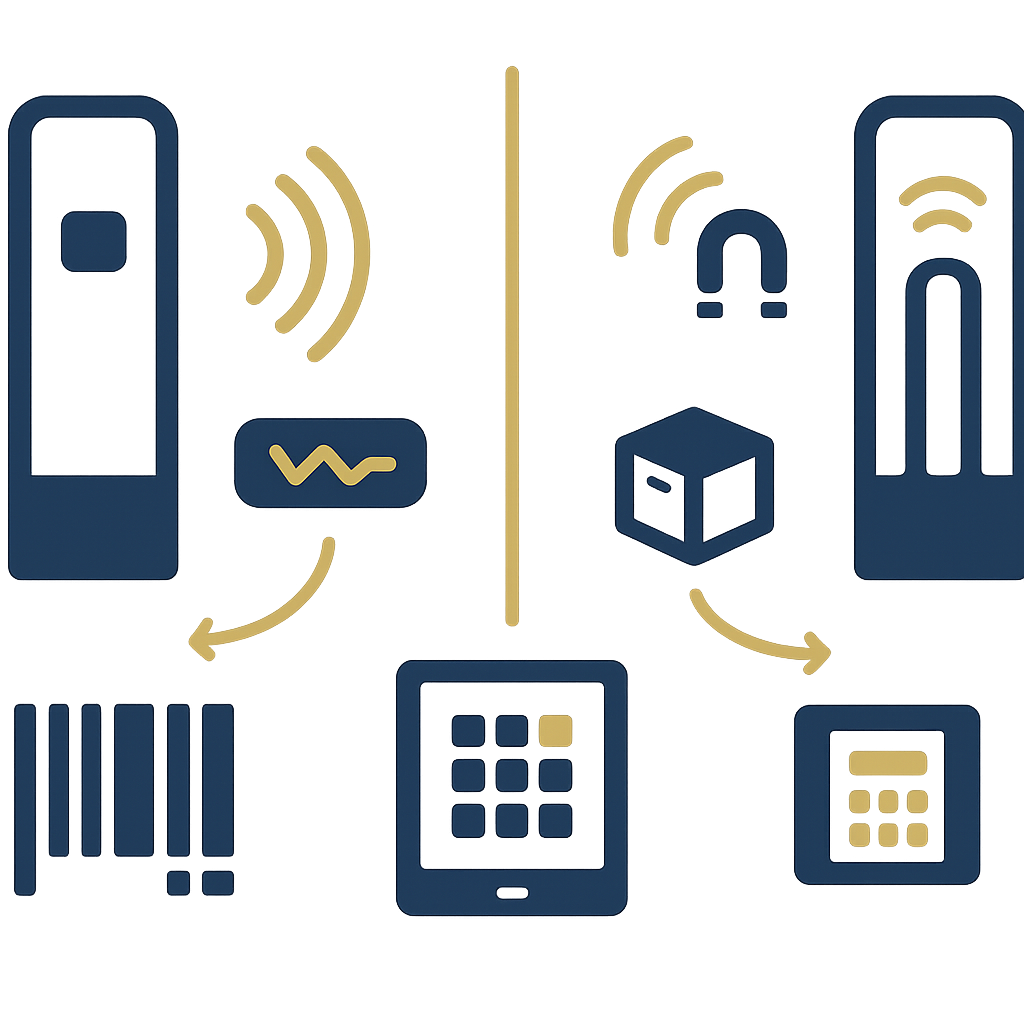
A store RFID gate is a UHF RFID reading system installed at the exit that reads the EPC code on each RFID label attached to an item. Each label carries a unique identifier, linked to the SKU and transaction in the point-of-sale software. When an item passes through the gate, the gate reads the code and sends it to the software to check against paid invoices. If the code has not been marked as sold, the gate triggers an alarm and logs the event with the item code, gate number, and timestamp.
The core difference is that EAS only knows that a tag that has not been deactivated has passed through, whereas RFID reads the code of each item, checks it against paid merchandise, and stores history by gate and time. For stores with many SKUs, this is a major operational difference: when an alarm triggers, staff immediately know which item is being taken out, can look up the related transaction, and can review events by hour. RFID gates also share labels with handheld readers used in inventory counting, so one label serves two purposes: security and inventory counting.
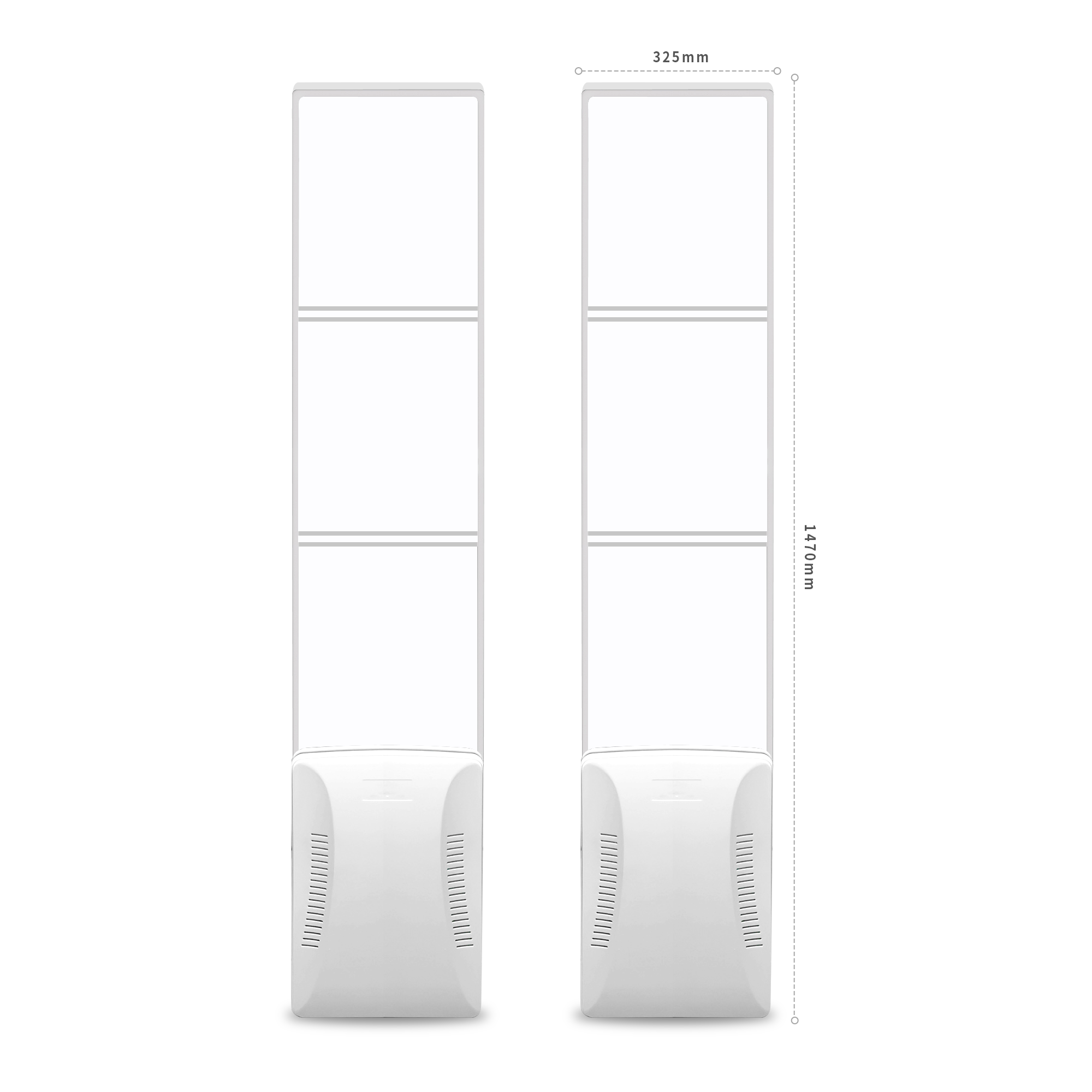
Technically, UHF RFID gates typically read according to the ISO 18000-6C / EPC Gen2 standard, in the 860–960 MHz band depending on the region. According to the manufacturer specifications of the IntelliGate A8 transparent RFID & EAS security gate, the device has two panels, each measuring 1470 × 325 × 129 mm, with an acrylic face, combining UHF RFID reading (ISO/IEC 18000-6B, 6C / EPC Gen2) and EAS, an adjustable output power of 0–33 dBm, a suggested read width of 1–2.4 m, and a 7 dBi phased array antenna. This is a combined gate line that lets stores run both technologies in parallel during the transition period.
Comparison table of EAS anti-theft gates and RFID gates by operational criteria
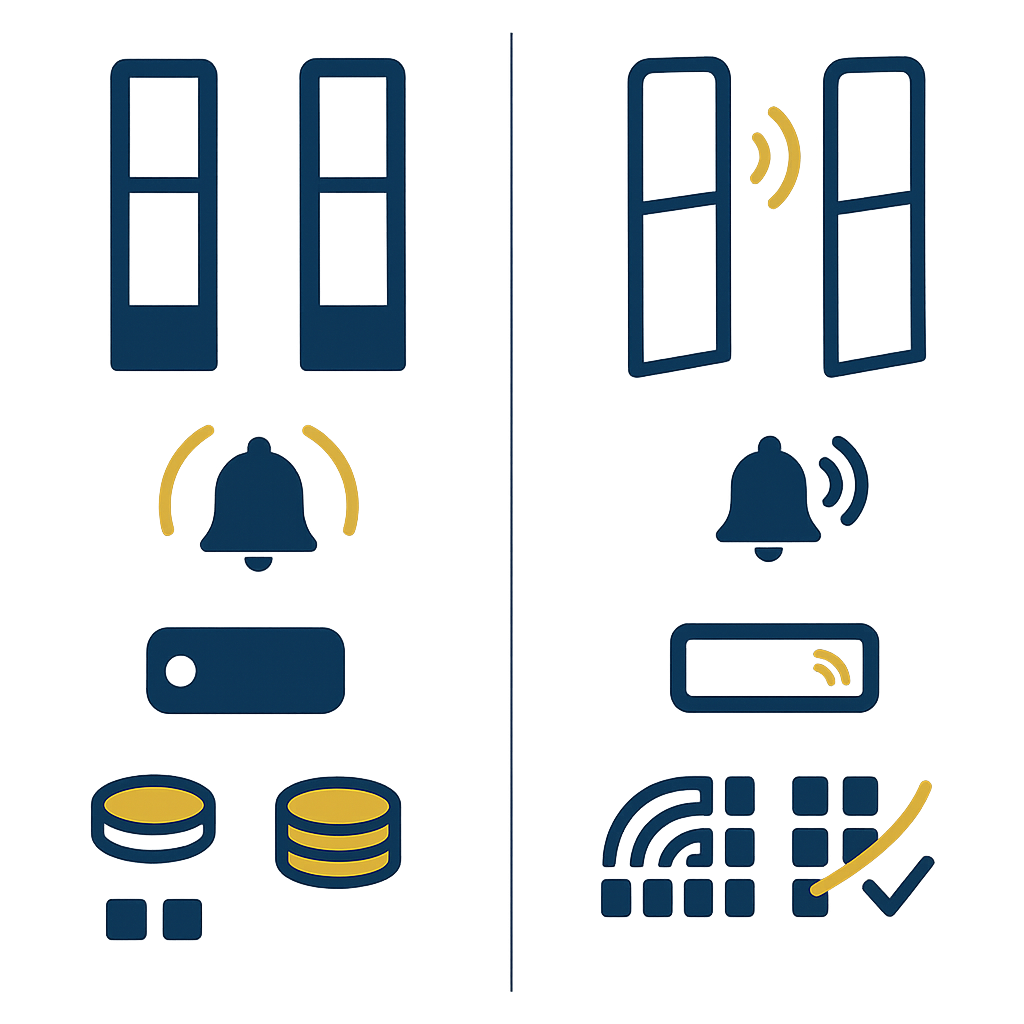
The table below compares EAS anti-theft gates and RFID gates across six criteria that store owners need to consider before investing: the information received when an alarm triggers, the type of tag used, tag cost, whether the tag can be shared for stocktaking, physical limitations, and the level of data recorded. The "example" column helps quickly cross-reference with real situations at the store.
| Criterion | EAS anti-theft gate | RFID gate | Operational example |
|---|---|---|---|
| Information received when an alarm triggers | Only know that a tag that has not been deactivated passed through | Know the item code, SKU, which gate, and at what time; can cross-check against the invoice | EAS: "someone went out through the gate". RFID: "jacket code 893... went out through gate 2 at 15:42, no invoice" |
| Type of tag | Hard magnetic tag, soft magnetic tag, adhesive tag | UHF RFID tag (hang tag, sticker, wet inlay) | EAS: hard tag attached to handbags. RFID: 97 × 27 mm hang tag attached to the garment label |
| Tag cost | Low, common, easy to buy | Higher than EAS tags, decreasing with order quantity | NXP U9 RFID tags in rolls of 2,000 labels; ordering in large quantities lowers the unit price |
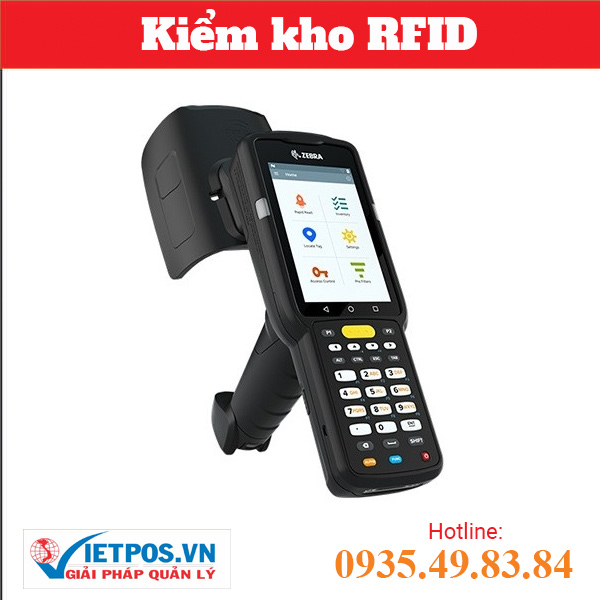
| Shared for stocktaking | No. EAS tags do not carry an SKU code | Yes. The same tag is used with a handheld reader for stocktaking | Zebra MC3390R reads the same RFID tags already attached to goods, stocktaking by batch |
| Physical limitations | Hard tags get in the way when folding goods; soft tags are easily covered by another label | Metal and liquids block UHF waves; must be tested on actual goods | Bottled cosmetics and metal accessories require re-measuring the read rate before finalizing |
| Data retained | No detailed log | Stores event history by gate and time | Review events during peak hours to audit the checkout process |
Combined RFID + EAS gate: an option for stores that want to migrate gradually
A combined RFID + EAS gate is a device that can read both UHF RFID tags and EAS tags on the same set of panels. Stores can run both tag types in parallel during the transition period: new goods carry RFID tags, while existing stock continues to use EAS tags until sold out. This approach avoids having to replace tags en masse immediately and avoids the risk of security gaps during the transition.
According to manufacturer specifications, the IntelliGate A8 gate supports optional EAS RF or AM expansion, reads UHF RFID per the ISO/IEC 18000-6B, 6C / EPC Gen2 standards, supports Windows/Android/Linux SDK, RJ45/RS232/RS485 connection ports, and fixed-frequency or frequency-hopping operating modes. Manufacturer-stated identification width: soft tags approximately 0.9 m, small square hard tags approximately 1.2 m, large square hard tags approximately 1.5 m. These figures are reference conditions, not a commitment for all types of goods — stores still have to measure on actual goods.
The gradual migration roadmap typically follows three steps:
- Step 1 — Run in parallel: keep EAS tags for existing stock, attach RFID tags to newly received goods. The combined gate reads both.
- Step 2 — Synchronize data: connect the gate to the sales software to cross-check paid invoices and record event logs.
- Step 3 — Fully switch to RFID: once the old stock has sold out, RFID tags cover all SKUs, and the same tags are used for periodic stocktaking with a handheld reader.
The loss-prevention solution using RFID + EAS gates is deployed according to this roadmap in Việt POS's RFID/EAS gate loss-prevention solution.
When is an EAS anti-theft gate enough?
An EAS anti-theft gate is enough when a store sells low-priced goods, has few SKUs, does not yet need RFID stocktaking, and staff mainly need an alarm layer at the door. Examples include phone accessory stores, grocery stores, and budget clothing stores under 30 m². At this scale, low EAS tag cost and fast tagging are a bigger advantage than data analysis capability.
Some signs that EAS is enough:
- Goods are mostly a few hundred thousand VND per item, and per-item loss is small.
- There is no POS software yet, or the software does not support RFID.
- There are few staff, and no one is responsible for periodic stocktaking.
- The floor area is small, there is one exit, and there is no need to analyze events by hour.
Conversely, fashion, cosmetics, and accessory stores with many SKUs, multi-location chains, and a need for periodic stocktaking get more value from an RFID gate or a combined gate. RFID tags shared for stocktaking help reduce stocktaking time and show exactly which items are missing.
Common mistakes when choosing and installing security gates
The most common mistake is choosing a gate based on device price while ignoring tag cost and long-term operating labor. The second mistake is expecting an RFID gate to read every item without testing on real goods, while metal and liquids block UHF waves. The third mistake is installing an EAS gate and an RFID gate too close together, causing interference. Below are the points to check before finalizing.
- Not measuring the read rate on real goods: RFID tags on cosmetic bottles, metal accessories, and bags with metal clasps usually read worse than tags on fabric. You must measure before ordering in large quantities.
- Placing the gate too close to the checkout counter: an RFID gate may misread tags on nearby shelves, causing false alarms. You need reasonable distance and a dead zone.
- Not connecting the gate to POS software: an RFID gate only delivers its value when it can reconcile against paid invoices. Without a connection, the gate works only as an expensive EAS.
- Using EAS tags stuck over RFID tags: the metal layer in an EAS tag can reduce the readability of the RFID tag underneath.
- Skipping staff training: staff need to know how to handle a gate alarm, how to look up an item code, and how to record events so nothing is missed.
Which gate to choose for your store: a 4-step process
The gate selection process has four steps: define the main goal (pure theft prevention or theft prevention plus stocktaking), measure the read rate on real goods, calculate tag cost and operating labor, then choose the gate type that fits the roadmap. The real-goods measurement step is mandatory for RFID because results depend on materials and tag placement.
- Define the goal: if you only need an alarm, EAS is enough. If you need to know which items are missing, do periodic stocktaking, and manage multiple locations, you need RFID.
- Measure the read rate: take samples of real goods, attach RFID tags in the correct position, and measure with a handheld reader or a test gate. Record the read rate by product group.
- Calculate total cost: gate cost + tag cost by quantity + tagging labor + training labor. Compare with the estimated value of lost goods.
- Choose the roadmap: pure EAS, pure RFID, or a combined gate with gradual migration. Stores with large inventory should choose a combined gate so they do not have to replace tags in bulk.
Việt POS provides on-site store surveys, measures the read rate on real goods, and advises on the migration roadmap. Contact the hotline 0935 498 384 or email info@vietpos.vn to book an appointment.
Frequently asked questions
Can an EAS gate read the code of each item?
No. An EAS gate only detects tags that have not been deactivated passing through the door; it cannot read the SKU or item information. To know exactly which item passed through the gate, you need an RFID gate that reads the EPC code on the RFID tag attached to each item. This is the core difference between the two technologies and the reason many retail chains are gradually moving to RFID as the number of SKUs grows.
Can an RFID gate fully replace an EAS gate?
Technically it can, but operationally it is not necessarily required. Stores with existing stock carrying EAS tags still need a gate that can read EAS tags during the transition period. A combined RFID + EAS gate such as IntelliGate A8 allows both tag types to run in parallel, avoiding the need to replace tags in bulk right away and avoiding a security gap during the transition.
Are RFID tags much more expensive than EAS tags?
UHF RFID tags have a higher unit price than EAS tags, but the gap narrows when ordering in large quantities. RFID tags are also shared for stocktaking, so one tag serves two purposes, while EAS tags are used only for security. Total cost must be calculated including the gate, tags, tag application labor and stocktaking labor for an accurate comparison.
Can an RFID gate read metal goods and cosmetic bottles?
Metal and liquids block UHF waves, so the read rate on these product groups is usually lower than on fabric. It can be improved by choosing a tag suited to the surface, placing the tag in the right position and adjusting the gate power. However, it must be measured on actual goods before finalizing the number of tags and the gate installation position. There is no commitment of 100% reading for all types of goods.
Does installing an RFID gate require connecting to the sales software?
Yes, if you want the gate to reconcile paid items and store the event history. The RFID gate sends the read codes to the software, the software checks the invoice and decides whether to trigger an alarm. Without connecting the software, the gate only works as an expensive EAS gate, losing most of its data value.
Which type should a small store under 50 m² choose?
Small stores selling low-priced goods usually only need an EAS gate because the tag cost is low and the operation is simple. Small stores selling high-value goods such as cosmetics and fashion accessories can consider an RFID gate or a combined gate if they have stocktaking and SKU management needs. The decision should be based on the estimated value of lost goods and operational goals, not only on floor area.
Need to compare EAS gates and RFID gates for your store's actual needs? Việt POS provides site surveys, measures read rates on actual goods and advises on a transition roadmap. Call the hotline 0935 498 384 or email info@vietpos.vn to book an appointment.
Need advice on specific equipment or a solution?
Việt POS replies within 30 minutes · Hotlines in 4 regions · Free site survey.
Related articles