Mục lục bài viết (10)
- Problems enterprises face with manual asset inventory
- How does the RFID asset inventory solution work?
- Specific benefits of applying RFID to fixed assets
- 7 steps to implement RFID fixed asset inventory for enterprises
- Checklist to avoid 5 common mistakes when implementing RFID
- Frequency regulations and compliance in Vietnam
- Cost and time comparison: Manual inventory vs RFID
- RFID asset inventory applications by industry
- Suitable RFID equipment for fixed asset inventory
- Frequently asked questions about RFID fixed asset inventory implementation
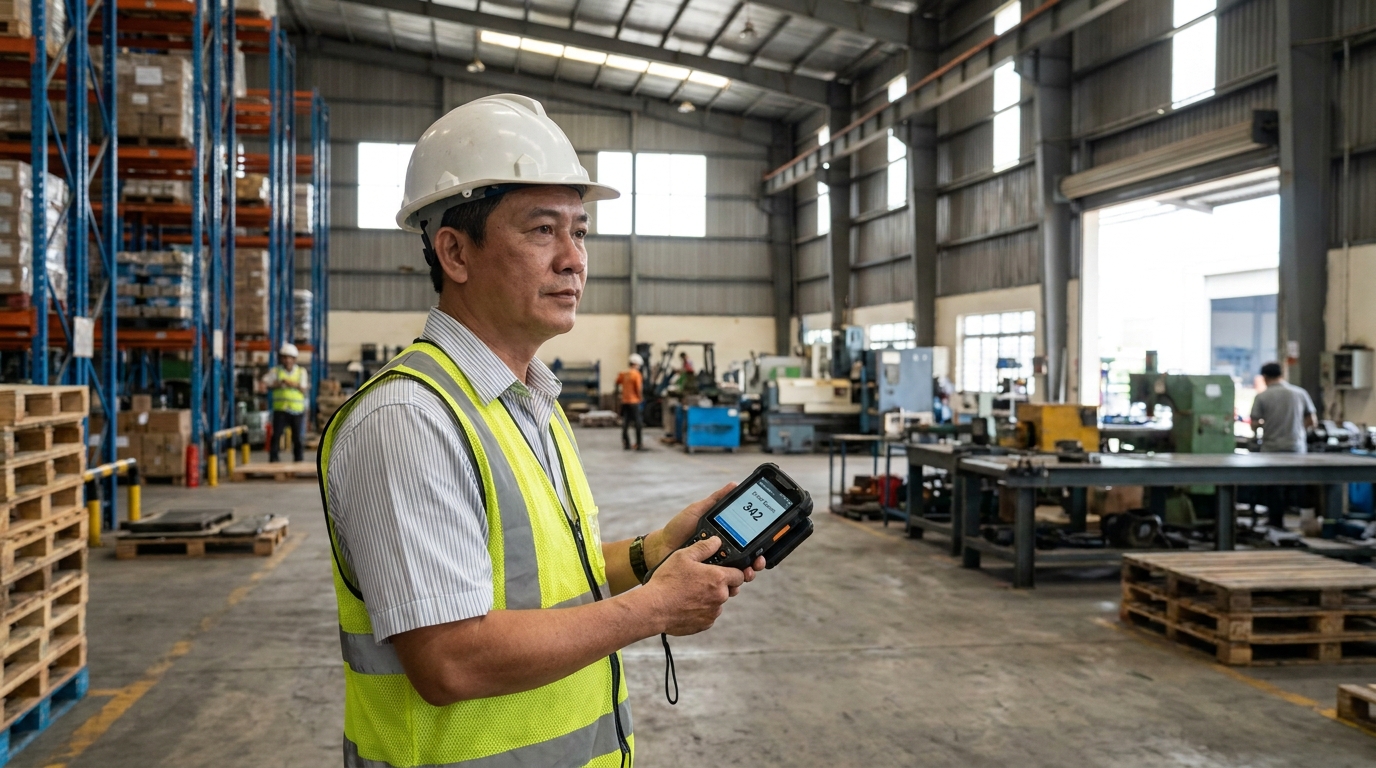
RFID fixed asset inventory is a solution that uses UHF radio waves to automatically identify and count assets (machinery, office equipment, vehicles, tools) without scanning each barcode individually. In Vietnam, this technology is being deployed in manufacturing plants, hospitals, schools, and retail chains to reduce inventory time from several days to a few hours, while minimizing errors from manual data entry.
Implementing RFID for fixed asset inventory requires 7 steps: site survey, coverage design, RFID tag selection (prioritizing on-metal tags for steel-enclosed equipment), software configuration, tag attachment, training, and acceptance. The compliant UHF frequency in Vietnam is 918.4-923 MHz, with power ≤500mW ERP per Circular 08/2021. Average implementation time is 4-8 weeks for enterprises with 500-2000 assets.
Table of Contents
- Problems enterprises face with manual asset inventory
- How does the RFID asset inventory solution work?
- Specific benefits of applying RFID to fixed assets
- 7 steps to implement RFID fixed asset inventory for enterprises
- Checklist to avoid 5 common mistakes when implementing RFID
- Frequency regulations and compliance in Vietnam
- Cost and time comparison: Manual inventory vs RFID
- RFID asset inventory applications by industry
- Suitable RFID equipment for fixed asset inventory
- Frequently asked questions about RFID fixed asset inventory implementation
Problems enterprises face with manual asset inventory

Manual or barcode-based fixed asset inventory is consuming 200-400 working hours per year for enterprises with 500-2000 assets, not to mention 5-15% data discrepancies due to data entry and lack of asset lifecycle control.
⚠ Losing 3-7 days per inventory cycle: Staff must stop their main work to scan each barcode, take notes, and reconcile records manually.
⚠ 5-15% data discrepancy: Assets are lost, borrowed without recording, or installation locations are recorded incorrectly, leading to inventory reports that do not match reality.
⚠ No lifecycle control: Difficulty tracking maintenance schedules, depreciation, internal transfers, and asset disposal — causing cost leakage.
⚠ Employee turnover loses traceability: Assets managed by individuals cannot have responsibility assigned when that person leaves the company.
⚠ Lack of real-time data: Management does not know exactly which assets are in operation, under repair, or out of service at any given time.
How does the RFID asset inventory solution work?
Related Products
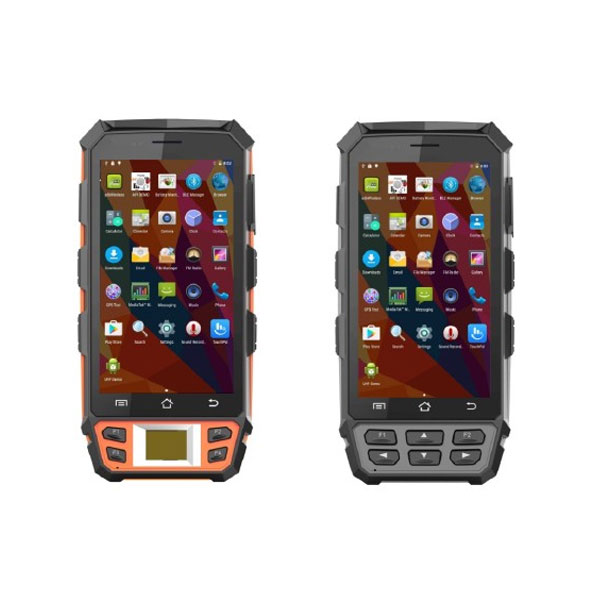
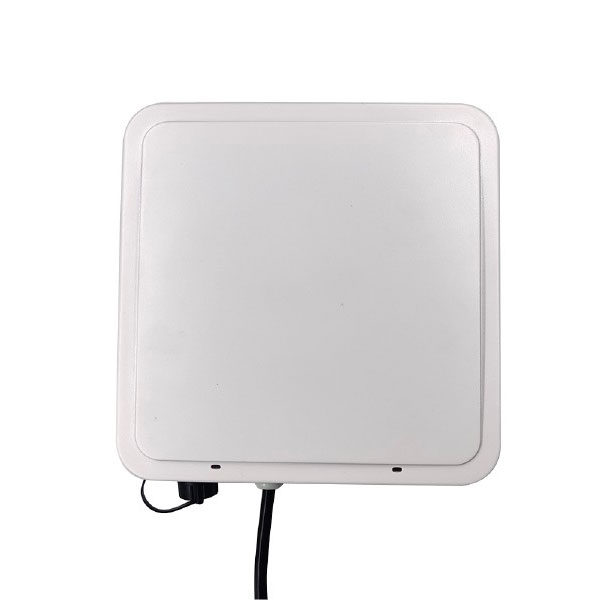


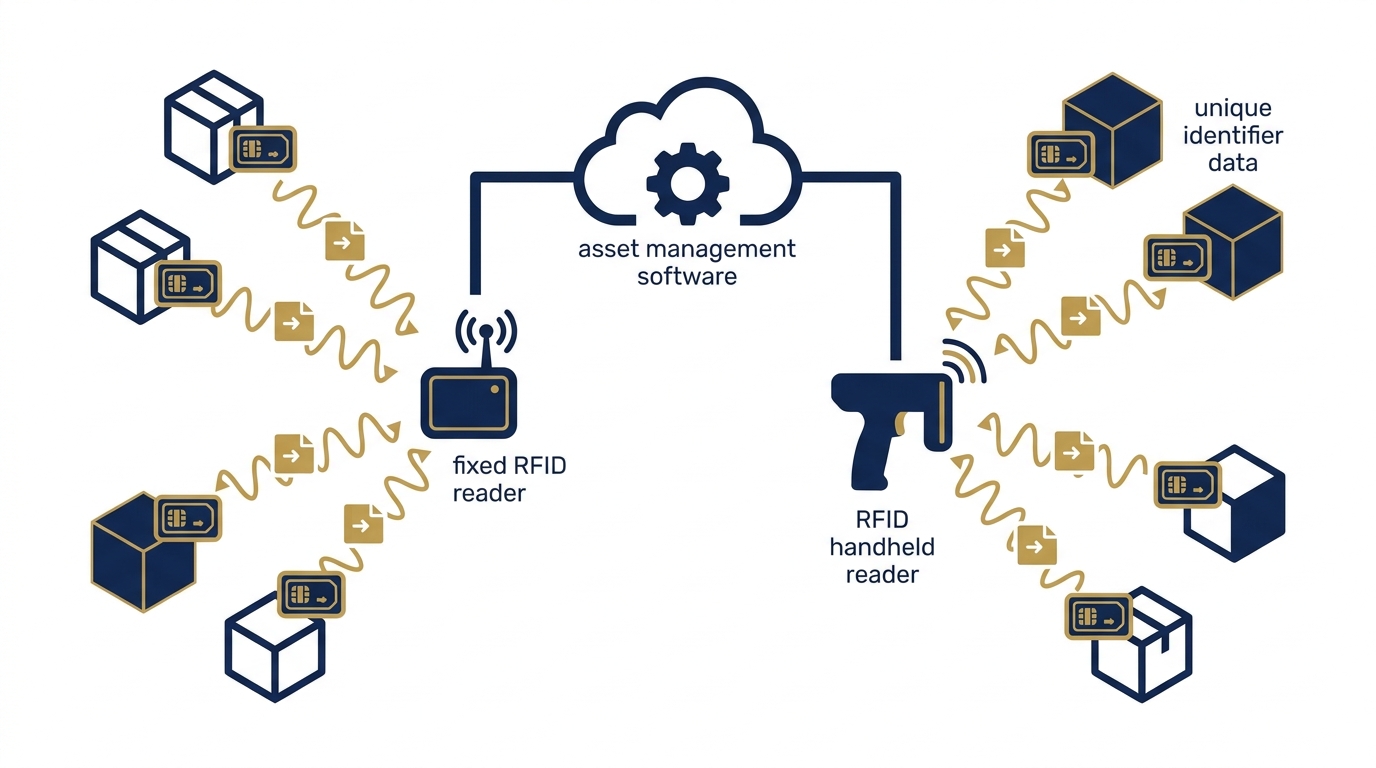
An RFID asset inventory system consists of UHF RFID tags attached to assets, handheld or fixed readers, and management software. When scanning, the reader emits waves at 918.4-923 MHz to activate the tags and receive the unique identification data of each asset within a 3-8 meter range.
- Attach RFID tags: Each asset is affixed with a UHF tag containing a unique identifier (EPC). On-metal tags are used for steel-enclosed equipment.
- Emit activation waves: The handheld reader emits radio waves in the 918.4-923 MHz frequency band (Vietnam regulations).
- Receive tag responses: The RFID tag receives energy from the waves and responds with the EPC code — no line-of-sight communication required.
- Transmit data to software: The reader sends data via Wi-Fi/Bluetooth to the asset management software, automatically updating quantity, location, and status.
- Automatic reconciliation: The software compares scanned data with the asset list, generating shortage/surplus reports within minutes.
Specific benefits of applying RFID to fixed assets
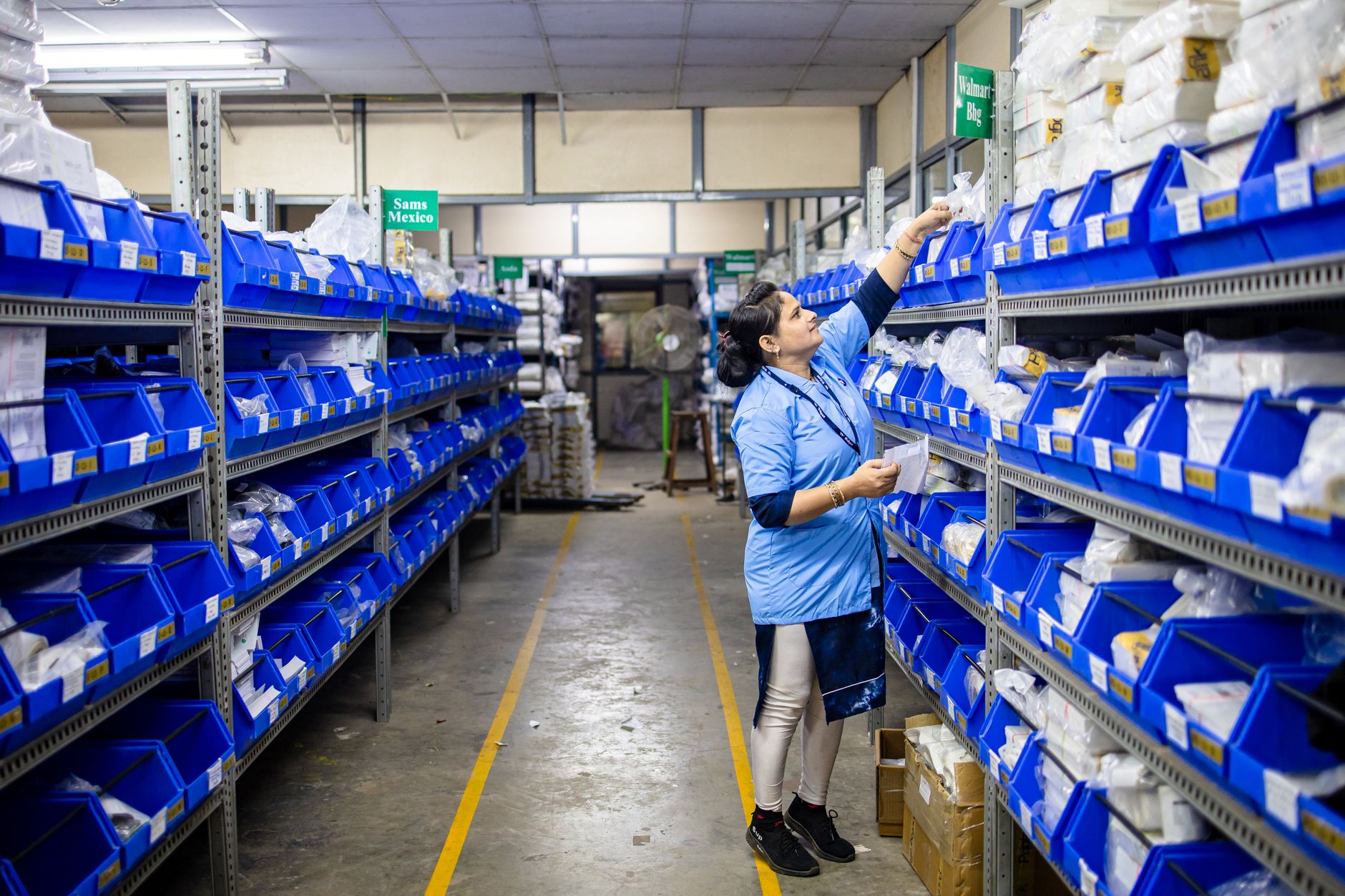
RFID helps enterprises reduce inventory time from 3-7 days to 2-4 hours per cycle, increase accuracy to over 98%, and control the entire asset lifecycle from procurement to disposal.
7 steps to implement RFID fixed asset inventory for enterprises
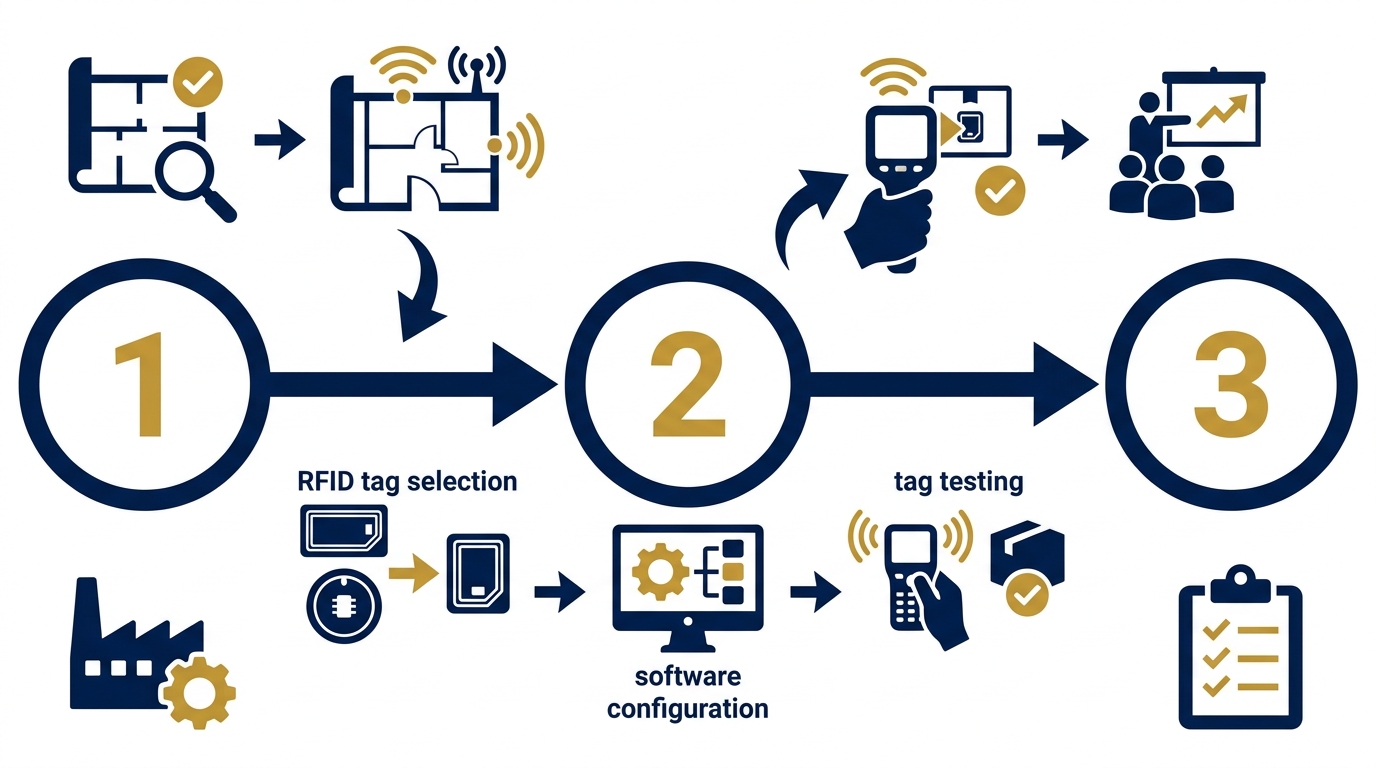
The standard implementation roadmap includes 7 steps: site survey, coverage design, RFID tag selection, software configuration, pilot tag attachment, staff training, and acceptance. Average time is 4-8 weeks for enterprises with 500-2000 assets.
Step 1: Site survey and asset classification
The technical team surveys the entire asset list: production machinery, office equipment, vehicles, tools. Classification is based on physical characteristics (metal, plastic, wood, glass), installation location (indoor, outdoor, humid areas), and importance level. Survey results determine the type of RFID tags and coverage design.
Step 2: Coverage design based on warehouse/area specifics
Each area has its own characteristics: metal warehouses block waves, office areas with many partitions, spacious factory floors. Technicians calculate the number of fixed readers, installation positions, and coverage angles. For assets distributed across multiple floors, the optimal solution is using handheld readers combined with fixed portals at entry/exit points.
Step 3: Selecting suitable RFID tags
Tag selection is the decisive factor for accuracy. Standard UHF tags are used for plastic/wood assets. For metal equipment, on-metal tags or tags with an isolation spacer are mandatory — otherwise, waves will be reflected by the metal surface, reducing read rates to 40-60%. Test on 10-20 actual assets before mass deployment to determine the optimal attachment position.
Step 4: Software configuration and integration
Asset management software is configured with the asset list, depreciation rates, and management departments. Data is imported from accounting software (MISA, QuickBooks, SAP) via Excel/CSV or API. The software is set up to automatically generate inventory reports, shortage/surplus lists, and maintenance reminders.
Step 5: Pilot tag attachment and testing
Attach tags to 20-50 representative assets (including metal, plastic, and liquid-containing assets) and test with handheld readers. Measure read rate, coverage range, and interference levels. Adjust tag positions or reader settings based on test results before mass deployment.
Step 6: Staff training
Train inventory staff on how to use handheld readers, how to attach tags correctly, and how to handle error cases (damaged tags, unreadable assets). Training time is typically 1-2 days, including hands-on practice on real assets.
Step 7: System acceptance and handover
Conduct a full inventory cycle to verify system accuracy. Acceptance criteria include: read rate ≥95%, inventory time reduced by at least 70%, and reports matching accounting records. After acceptance, hand over the system to the operations team and schedule periodic maintenance.
Checklist to avoid 5 common mistakes when implementing RFID
Common mistakes include: using standard tags on metal surfaces, not testing coverage in actual environments, skipping staff training, not integrating with accounting software, and not planning for tag maintenance. Avoid these to ensure project success.
- Mistake 1: Using standard tags on metal surfaces — Read rate drops to 40-60%. Use on-metal tags or add an isolation layer.
- Mistake 2: Not testing coverage in actual environments — Metal racks, concrete walls, and liquids affect wave propagation. Always conduct a pilot test.
- Mistake 3: Skipping staff training — Untrained staff may attach tags incorrectly or mishandle readers, leading to poor results.
- Mistake 4: Not integrating with accounting software — Without integration, data must be manually entered, defeating the purpose of automation.
- Mistake 5: Not planning for tag maintenance — Tags can be damaged or lost; plan for spare tags and periodic checks.
Frequency regulations and compliance in Vietnam
Per Circular 08/2021/TT-BTTTT, UHF RFID devices operate in the 918.4-923 MHz band with maximum transmit power of 500mW ERP. Devices must have compliance certification before circulation. Việt POS provides compliant equipment, but enterprises should consult authorities for current procedures.
Cost and time comparison: Manual inventory vs RFID
Manual inventory costs 200-400 labor hours per year with 5-15% error rate. RFID reduces time by 80-90% and increases accuracy to over 98%, with an average payback period of 2-3 years for enterprises with 1000 assets.
| Criteria | Manual | RFID |
|---|---|---|
| Time per cycle (500 assets) | 3-7 days | 2-4 hours |
| Accuracy | 85-95% | ≥98% |
| Labor cost per year | 200-400 hours | 20-40 hours |
| Data entry errors | High | Minimal |
| Real-time visibility | No | Yes |
| Initial investment | Low | 50-150 million VND |
| Payback period | N/A | 2-3 years |
RFID asset inventory applications by industry
RFID is applied across industries: manufacturing (machinery tracking), healthcare (medical equipment), education (lab equipment), retail (store fixtures), and logistics (vehicles). Each industry has specific requirements for tag types and read ranges.
Suitable RFID equipment for fixed asset inventory
Key equipment includes handheld readers (for flexible scanning), fixed readers and antennas (for portals), and RFID tags (standard, on-metal, and high-temperature variants). Choose based on asset types and inventory frequency.
Frequently asked questions about RFID fixed asset inventory implementation
What is the investment cost for RFID fixed asset inventory?
Cost depends on scale and asset type. For enterprises with 500-1000 assets, total investment is approximately 50-150 million VND, including: handheld readers (15-40 million VND each), RFID tags (3,000-15,000 VND per tag depending on on-metal or standard), management software (10-30 million VND), and survey/implementation costs. Enterprises can start with a small package of 30-50 million VND for one area, then expand gradually.
How long does RFID system implementation take?
For enterprises with 500-2000 assets, average implementation time is 4-8 weeks: site survey 3-5 days, coverage design 2-3 days, equipment and tag procurement 1-2 weeks (including import lead time), tag attachment and software configuration 1-2 weeks, training and acceptance 3-5 days. Large projects with over 5000 assets may take 8-12 weeks due to the volume of tag attachment.
Can RFID read metal assets?
Yes, but specialized on-metal tags must be used. Standard UHF tags experience signal interference when attached directly to metal surfaces, reducing read rates to 40-60%. On-metal tags have a ferrite isolation layer, achieving 95-99% read rates when attached correctly. Test on 10-20 actual assets before mass deployment to determine optimal positions.
Can RFID software integrate with existing accounting software?
Yes. RFID asset management software supports data import/export in Excel/CSV format and can sync with accounting software (MISA, QuickBooks, SAP) via API or periodic files. Depreciation data, original cost, and managing departments are imported from the accounting system into the RFID software. After inventory, results are exported back for reconciliation.
What is the difference between RFID for asset inventory and RFID for warehouse management?
RFID for asset inventory focuses on tracking fixed assets (machinery, equipment, vehicles) with high value and long service life, requiring lifecycle and depreciation management. RFID for warehouse management tracks inventory items with large quantities, fast turnover, and continuous inbound/outbound. Hardware is similar, but software differs: asset software has modules for depreciation, maintenance, and transfers; warehouse software has modules for inbound/outbound, FIFO, and stock counting.
How to calculate ROI when investing in RFID asset inventory?
Calculate ROI based on 3 benefit sources: (1) labor savings — if inventory is done 2-4 times per year, each taking 200-400 labor hours, RFID reduces time by 80-90%; (2) reduced asset loss — each lost asset is worth 10-100 million VND, RFID helps trace and prevent; (3) optimized maintenance costs — tracking maintenance schedules on time extends equipment life. For enterprises with 1000 assets, payback period is typically 2-3 years.
What are the limitations of RFID for asset inventory?
RFID has 3 main limitations: (1) waves are blocked by metal and liquids — requiring on-metal tags and real-world coverage testing; (2) tag cost for large quantities — with 5000+ assets, tag costs can reach 15-75 million VND; (3) staff still need visual confirmation before recording — RFID does not completely replace physical inspection, especially for assets in use or damaged.
What are the RFID frequency regulations in Vietnam?
According to Circular 08/2021/TT-BTTTT of the Ministry of Information and Communications, UHF RFID devices operate in the 918.4-923 MHz band with maximum transmit power of 500mW ERP. Devices must have compliance certification before circulation. Việt POS provides RFID equipment meeting national technical standards, but enterprises should contact regulatory authorities directly for accurate procedures at any given time.
Cần tư vấn thiết bị/giải pháp cụ thể?
Việt POS phản hồi trong 30 phút · Hotline 4 vùng · Khảo sát miễn phí.
