
Mục lục bài viết (9)
- What is manual inventory and who uses it?
- How does RFID location & sorting in the warehouse work?
- Detailed comparison: Manual inventory vs RFID location in the warehouse
- How much does productivity increase when switching from manual to RFID?
- Which method to choose based on warehouse scale?
- What are the pros and cons of each method?
- Which RFID frequency is compliant in Vietnam?
- What is the roadmap for deploying RFID in a warehouse?
- Frequently Asked Questions
Manual inventory and RFID location & sorting in the warehouse are two fundamentally different inventory management methods. This article directly compares the two approaches — execution time, accuracy, labor costs, and location capability — to help you choose the right solution for your warehouse scale.
Manual inventory of a 1,000m² warehouse takes 2-3 days with 85-92% accuracy. RFID location & sorting in the warehouse reduces this to 3-5 hours with 98-99% accuracy, cutting time by 70-80% and labor costs by 60-70%. Suitable for warehouses of 500m² or more or with >5,000 SKUs.
Table of Contents
- What is manual inventory and who uses it?
- How does RFID location & sorting in the warehouse work?
- Detailed comparison: Manual inventory vs RFID location in the warehouse
- How much does productivity increase when switching from manual to RFID?
- Which method to choose based on warehouse scale?
- What are the pros and cons of each method?
- Which RFID frequency is compliant in Vietnam?
- What is the roadmap for deploying RFID in a warehouse?
- Frequently Asked Questions
What is manual inventory and who uses it?

Manual inventory is the process of counting and reconciling stock using paper records, Excel spreadsheets, or handheld scanners that read each barcode individually. This method suits warehouses under 200m², with fewer than 1,000 SKUs, or businesses that are newly operating and lack the budget for technology infrastructure.
In practice in Vietnam, many small distribution warehouses still conduct inventory this way: 3-5 employees halt all inbound and outbound operations, divide areas, count each shelf, and record on paper forms or enter data into Excel afterward. This process is typically done at the end of the month or quarter.
How does RFID location & sorting in the warehouse work?
Related Products
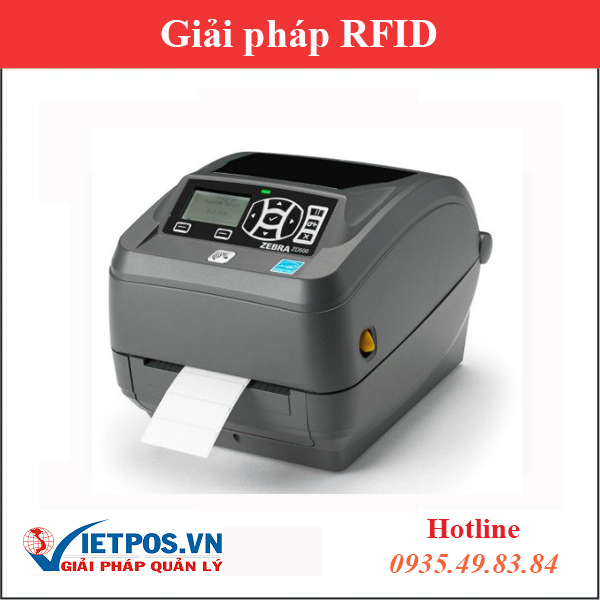
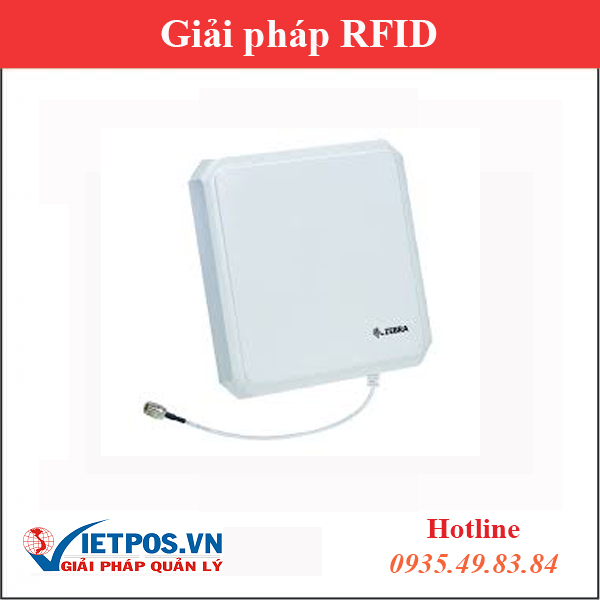
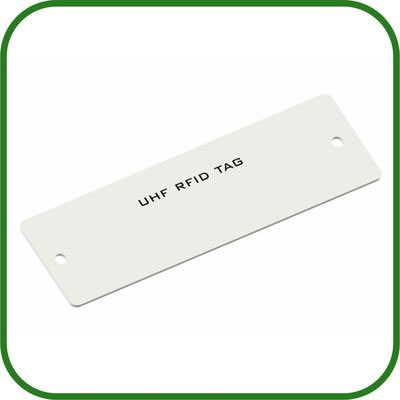



RFID location & sorting in the warehouse uses RFID tags attached to pallets or individual cartons, combined with fixed or handheld readers to scan in bulk without needing to see each barcode. The system automatically records location, quantity, and updates in real time to the management software.
Unlike manual inventory which requires reading each barcode one by one, UHF RFID readers can scan 200-500 tags in 3-5 seconds. When an employee walks through a shelf area with a handheld reader, all tags within a 5-10 meter radius are automatically recorded. Data is reconciled with the system to identify missing, excess, or misplaced items.
Detailed comparison: Manual inventory vs RFID location in the warehouse

When comparing across 6 main criteria — time, accuracy, labor costs, location capability, inventory frequency, and investment cost — RFID excels in the first 5 criteria. Manual inventory only wins on initial upfront cost.
| Criteria | Manual Inventory | RFID Location & Sorting | Conclusion |
|---|---|---|---|
| Inventory time for 1,000m² warehouse | 2-3 days | 3-5 hours | Best: RFID (reduces 70-80%) |
| Accuracy | 85-92% | 98-99% | Best: RFID |
| Required labor | 3-5 people | 1-2 people | Best: RFID (reduces 60-70%) |
| Detecting misplaced items | Cannot detect | Immediate detection | Best: RFID |
| Inventory frequency | End of month/quarter | Daily or real-time | Best: RFID |
| Initial investment cost | Nearly zero | 80-300 million VND | Best: Manual |
The table above shows: if your warehouse is under 200m² and has fewer than 1,000 SKUs, RFID investment does not yet yield clear economic benefits. Conversely, for warehouses of 500m² or more or with over 5,000 SKUs, RFID significantly saves labor costs and reduces inventory errors.
How much does productivity increase when switching from manual to RFID?
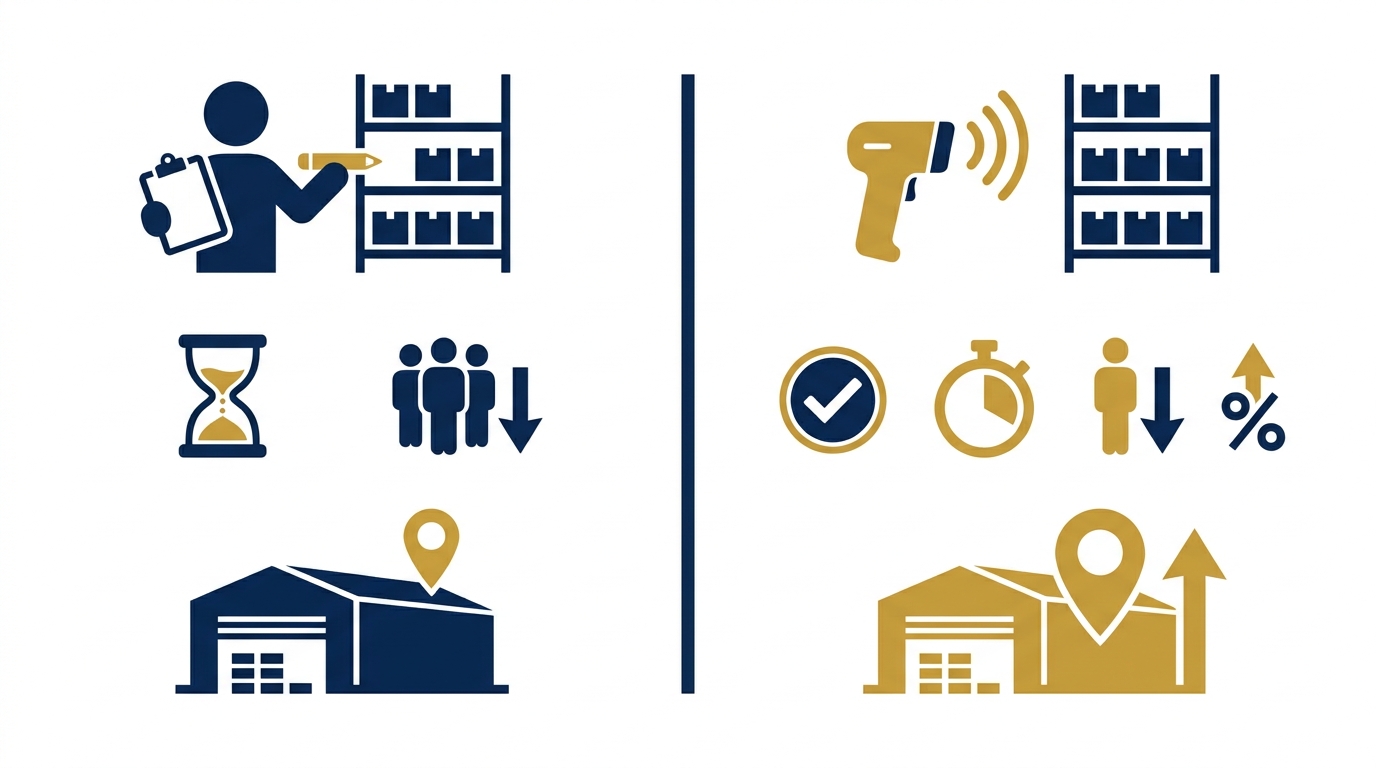
Real data from a distribution warehouse in Binh Duong with 1,200m² and 8,000 SKUs: inventory time decreased from 2.5 days to 4 hours, accuracy increased from 88% to 99%. Labor productivity per person increased 5-7 times.
Typical case study: a food distribution warehouse in Binh Duong adopted RFID in Q3/2024. Results measured after 6 months:
- Periodic inventory time: 2.5 days → 4 hours (reduced 84%)
- Inventory accuracy: 88% → 99% (increased 11 percentage points)
- Number of inventory staff: 4 people → 1 person (reduced 75%)
- Time to locate items during outbound: 15-20 minutes → 2-3 minutes (reduced 85%)
- End-of-month inventory discrepancy: 3-5% → below 0.5%
Businesses can conduct rolling inventory of each area daily instead of closing the warehouse for 2-3 days each month-end. This maintains continuous inbound and outbound operations without disrupting orders.
Which method to choose based on warehouse scale?
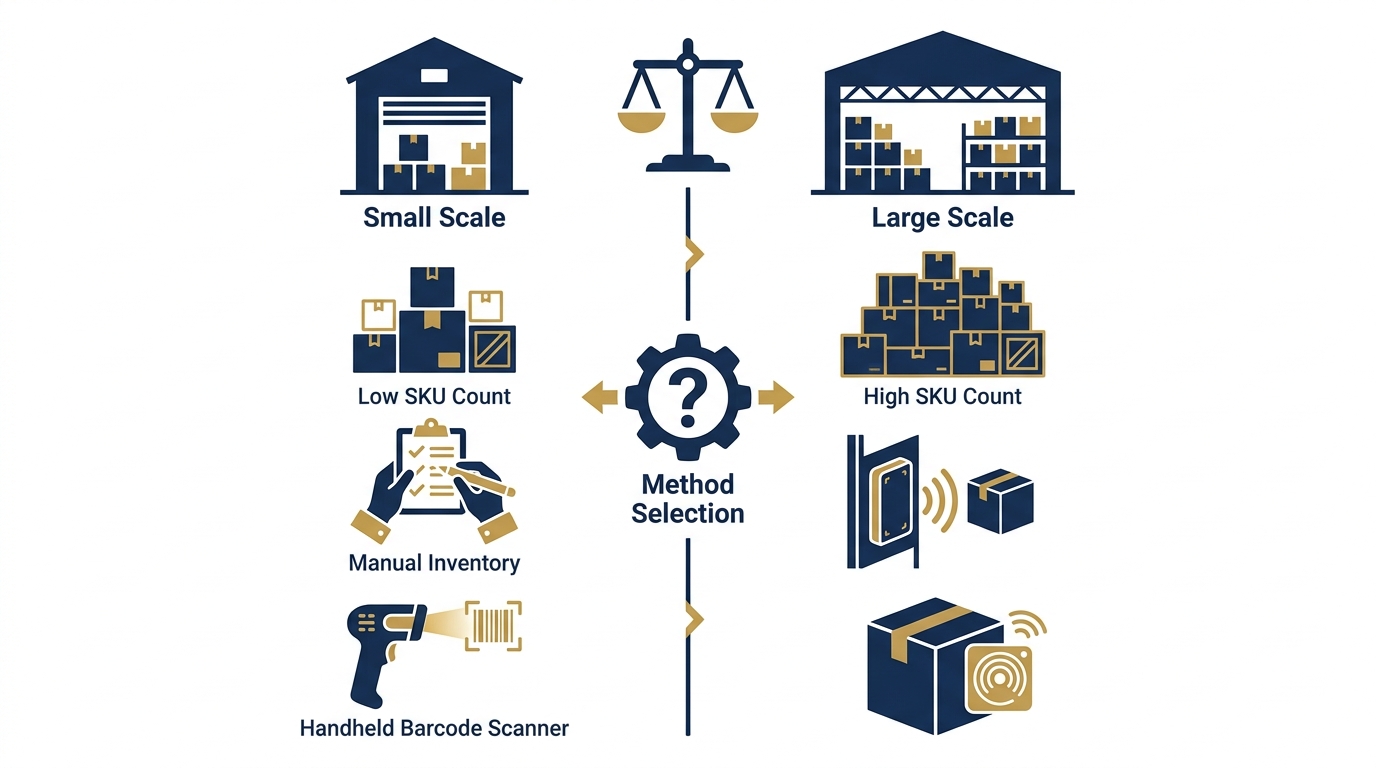
There is no single right solution for every warehouse. The decision depends on area, number of SKUs, inbound/outbound frequency, and investment budget. Below are specific recommendations for each group.
Warehouse under 200m², under 1,000 SKUs: Continue with manual inventory or use handheld barcode scanners. RFID investment costs are not yet offset by savings value. A budget of 80-300 million VND should be used for business expansion.
Warehouse 200-500m², 1,000-5,000 SKUs: Consider phased RFID deployment — starting with high-value or fast-moving items. Invest in 1 handheld reader + RFID tags for 30-50% of SKUs first.
Warehouse over 500m², over 5,000 SKUs: Should invest in comprehensive RFID. With current inventory labor costs of 20-30 million VND/month, the expected payback period is 12-24 months. The system includes handheld readers, RFID portals at inbound/outbound doors, and management software.
What are the pros and cons of each method?
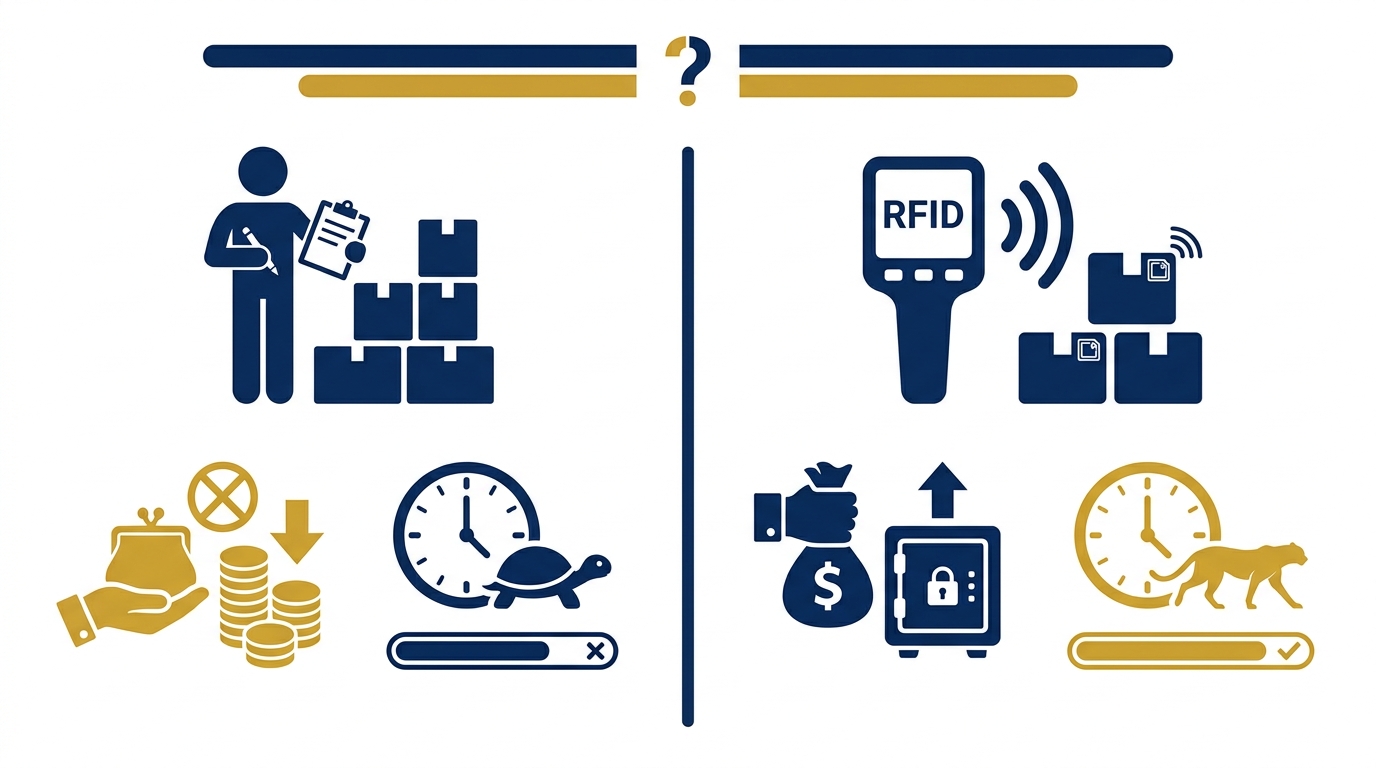
Manual inventory is simple, requires no investment, and is easy to implement, but is slow, error-prone, and cannot detect misplaced items. RFID provides speed, accuracy, and real-time visibility, but requires investment and has limitations with metal and liquid interference.
Manual inventory advantages: no initial investment, no training required, flexible for any warehouse size. Disadvantages: time-consuming, prone to errors, requires stopping operations, and cannot detect misplaced items.
RFID advantages: fast scanning, high accuracy, real-time updates, detects misplaced items, and reduces labor. Disadvantages: initial investment cost, requires technical infrastructure, and performance can be affected by metal and liquid environments.
Which RFID frequency is compliant in Vietnam?

In Vietnam, UHF RFID operates in the 918.4-923 MHz band as regulated by Circular 08/2021/TT-BTTTT. Devices must comply with this frequency range and power limits to be legally used. Most international UHF RFID equipment supports this band.
When deploying RFID in Vietnam, ensure that readers and tags support the 918-923 MHz frequency range. Some devices imported from other regions may be configured for different bands (e.g., 865-868 MHz in Europe or 902-928 MHz in the US) and require adjustment or certification.
What is the roadmap for deploying RFID in a warehouse?

A typical RFID deployment roadmap includes 5 steps: assessment and planning, pilot implementation, full deployment, integration with existing systems, and training and optimization. Each step takes 2-4 weeks, with total deployment time of 2-4 months.
- Assessment and planning: Analyze current inventory processes, identify pain points, define goals, and calculate ROI. Determine the scope of deployment (which areas, which SKUs).
- Pilot implementation: Deploy RFID in a small area (e.g., one shelf row or one product category). Test tag placement, reader configuration, and software integration. Measure results against baseline.
- Full deployment: Expand RFID to the entire warehouse. Install fixed readers at doors, equip handheld readers for staff, and tag all items. Configure software for real-time tracking.
- Integration with existing systems: Connect RFID data to ERP or WMS systems. Ensure data flows seamlessly for inventory updates, order fulfillment, and reporting.
- Training and optimization: Train staff on new processes and equipment. Continuously monitor performance, adjust tag placement, and optimize reader settings for maximum accuracy.
Frequently Asked Questions
Is RFID inventory 100% accurate?
No. RFID achieves 98-99% accuracy under standard conditions. Read rates can decrease when tags are attached to metal surfaces or near liquids due to radio wave interference. For these areas, use specialized anti-metal tags or supplement with manual checks.
What is the investment cost for RFID location & sorting in the warehouse?
Costs range from 80-300 million VND for a 500-2,000m² warehouse, including: handheld readers (15-40 million VND/unit), fixed RFID portals (40-80 million VND/set), RFID tags (3,000-8,000 VND/tag), and management software (30-80 million VND). Actual costs depend on the number of tags and deployment scope.
When should I invest in RFID instead of continuing manual inventory?
Invest when the warehouse has over 5,000 SKUs, an area over 500m², or when inventory labor costs exceed 15-20 million VND/month. If manual inventory disrupts inbound/outbound operations for more than 1 day per month, RFID will help eliminate this bottleneck.
Do warehouse staff need special skills to use RFID?
No. The main operation is carrying a reader through shelf areas or passing goods through fixed portals. Staff only need 2-3 hours of training to become familiar with the equipment and software. However, confirmation procedures before recording should be established to avoid operational errors.
Does RFID completely replace inventory staff?
Not completely. RFID reduces the number of required staff from 3-5 people to 1-2 people, but still requires operators for readers, checking weak-signal areas, and handling discrepancies. Staff are reassigned to higher-value tasks such as inventory analysis and storage location optimization.
Cần tư vấn thiết bị/giải pháp cụ thể?
Việt POS phản hồi trong 30 phút · Hotline 4 vùng · Khảo sát miễn phí.
