Mục lục bài viết (11)
- What steps are involved in processing a container through a warehouse gate?
- How long does each manual processing step take?
- How does an RFID warehouse gate system work?
- Detailed comparison: Manual vs RFID across 5 criteria
- Which method to choose based on scenarios?
- What are the pros and cons of each method?
- What is the investment cost for an RFID warehouse gate?
- Which frequency is compliant for RFID warehouse gates in Vietnam?
- When should you invest in an RFID warehouse gate?
- Step-by-step guide to implementing an RFID warehouse gate
- Frequently Asked Questions
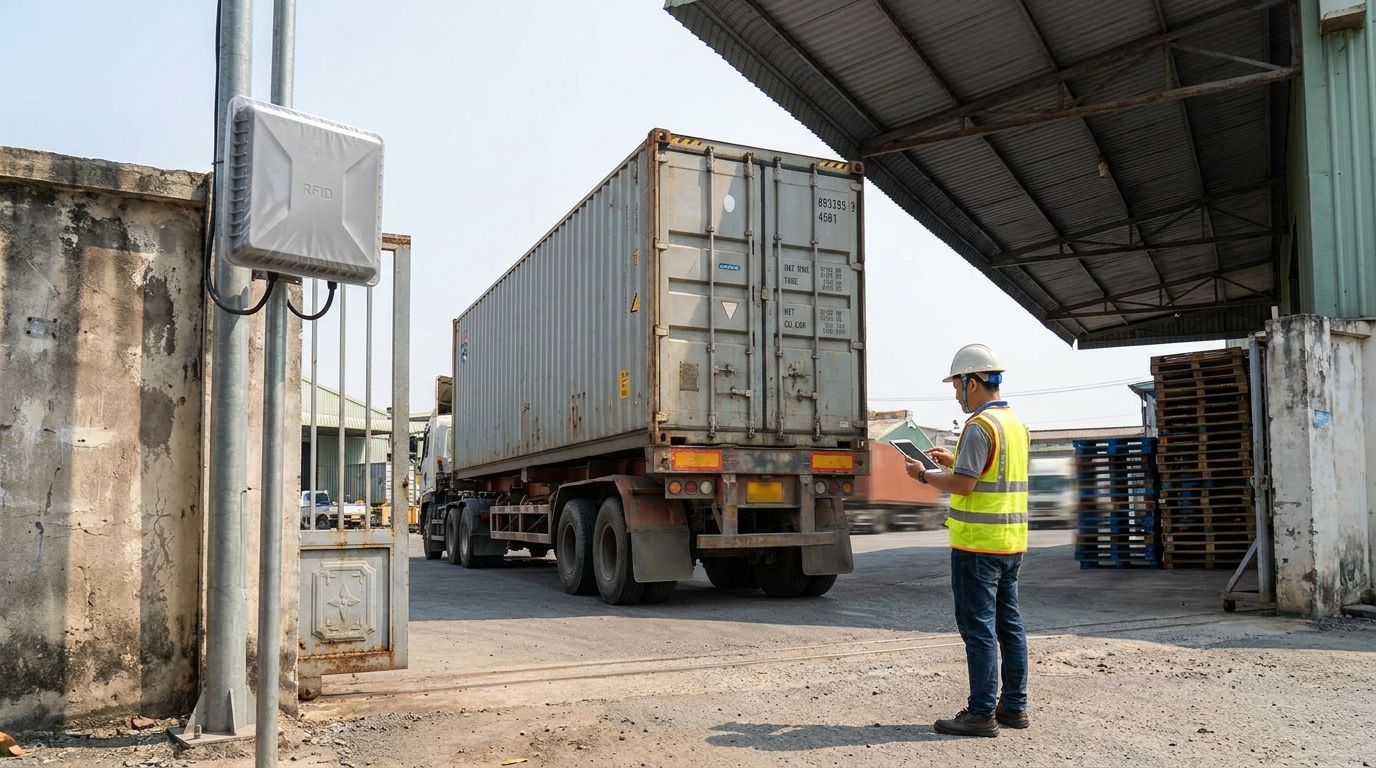
Processing a 40-foot container through a warehouse gate is a matter of time and accuracy. The manual method with paperwork, manual data entry, and visual verification typically takes 45-60 minutes per vehicle, while an RFID warehouse gate system automates and reduces this to 3-5 minutes. This article compares the two methods in detail across a 5-step process, with measured data and hidden costs, to help you decide when to invest.
Manual container processing at warehouse gates takes 45-60 minutes per container with 4-5 staff due to manual data entry and document verification. A UHF RFID system automates this process down to 3-5 minutes with 1 supervisor, thanks to simultaneous reading of tags attached to containers/vehicles. The main bottleneck of manual processing is the document verification and manual data entry step, causing 1-3% errors. RFID is suitable when the warehouse handles over 20 containers/day, with an investment cost of 80-250 million VND and a payback period of 12-18 months.
Table of Contents
- What steps are involved in processing a container through a warehouse gate?
- How long does each manual processing step take?
- How does an RFID warehouse gate system work?
- Detailed comparison: Manual vs RFID across 5 criteria
- Which method to choose based on scenarios?
- What are the pros and cons of each method?
- What is the investment cost for an RFID warehouse gate?
- Which frequency is compliant for RFID warehouse gates in Vietnam?
- When should you invest in an RFID warehouse gate?
- Step-by-step guide to implementing an RFID warehouse gate
- Frequently Asked Questions
What steps are involved in processing a container through a warehouse gate?
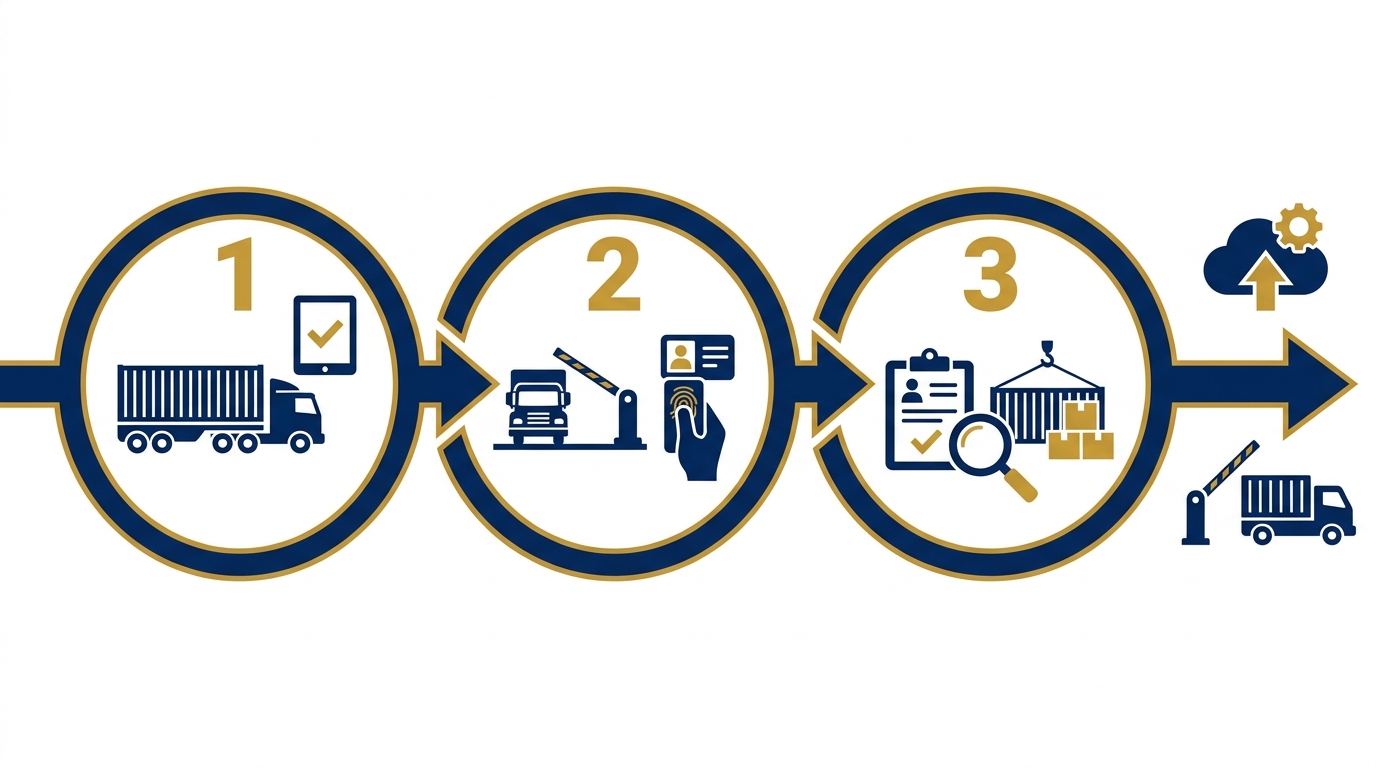
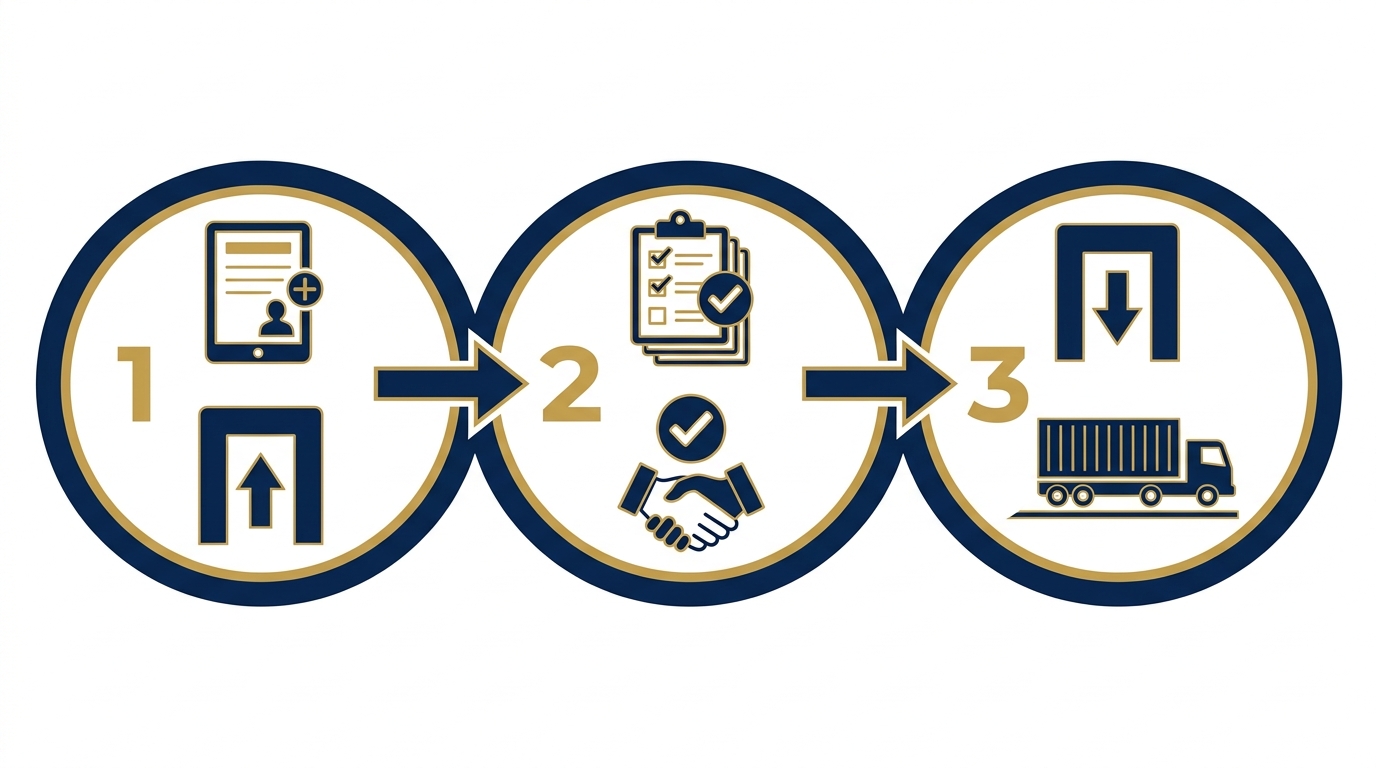
The standard process has 5 steps: (1) registering shipment information, (2) vehicle entering the gate and identity confirmation, (3) verifying documents against actual goods, (4) confirming and updating the system, (5) vehicle exiting the gate. Each step has different processing times between manual and RFID, creating a large difference in total time.
Both methods must go through these 5 steps. The difference lies in execution: manual relies on human data entry and paper verification, while RFID relies on automatic wave reading and digital data matching. This difference creates a 10-12x gap in processing time.
How long does each manual processing step take?
Related Products
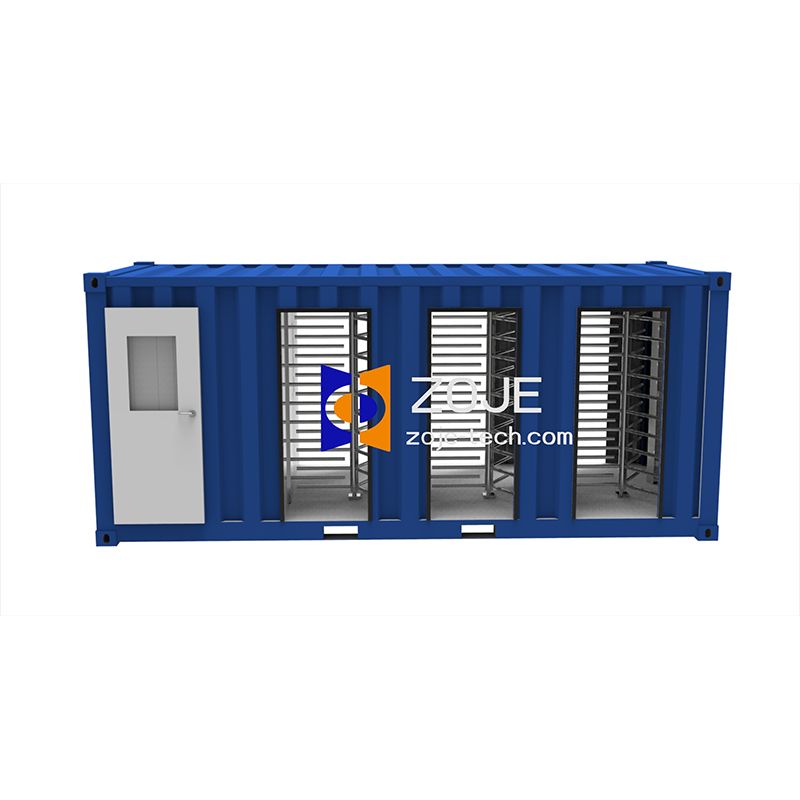


Actual measurements at a 5,000m² distribution center show: registration 5-8 minutes, gate entry 3-5 minutes, verification 20-30 minutes, confirmation 10-15 minutes, exit 2-3 minutes. Total 40-60 minutes per container, with the verification step accounting for 50% of the time and being the main bottleneck.
| Step | Manual | RFID | Difference |
|---|---|---|---|
| 1. Registration | 5-8 minutes | 1-2 minutes | 4-6 minutes |
| 2. Gate entry | 3-5 minutes | 0.5-1 minute | 2.5-4 minutes |
| 3. Verification | 20-30 minutes | 1-2 minutes | 19-28 minutes |
| 4. Confirmation | 10-15 minutes | 1-2 minutes | 9-13 minutes |
| 5. Exit | 2-3 minutes | 0.5-1 minute | 1.5-2 minutes |
| Total | 40-60 minutes | 4-8 minutes | 36-52 minutes |
The document verification step is the most time-consuming because staff must check each item type, quantity, and batch code on paper against the actual goods on the vehicle. Data entry errors of 1-3% lead to rework, adding 10-15 minutes each time.
How does an RFID warehouse gate system work?
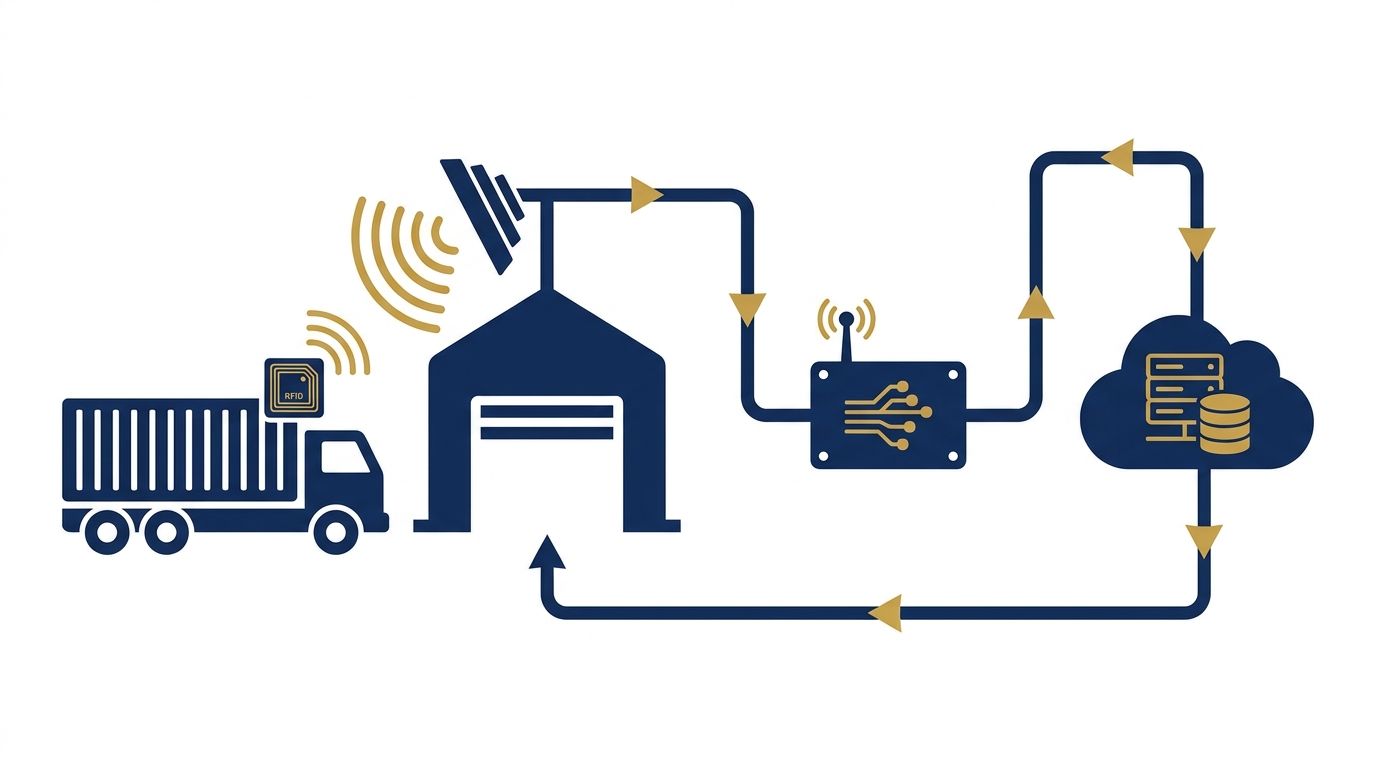
An RFID warehouse gate uses fixed UHF readers installed at the gate to automatically read RFID tags attached to containers or vehicles as they pass through. The read data is transmitted to management software, automatically matching against pre-registered information, minimizing manual intervention.
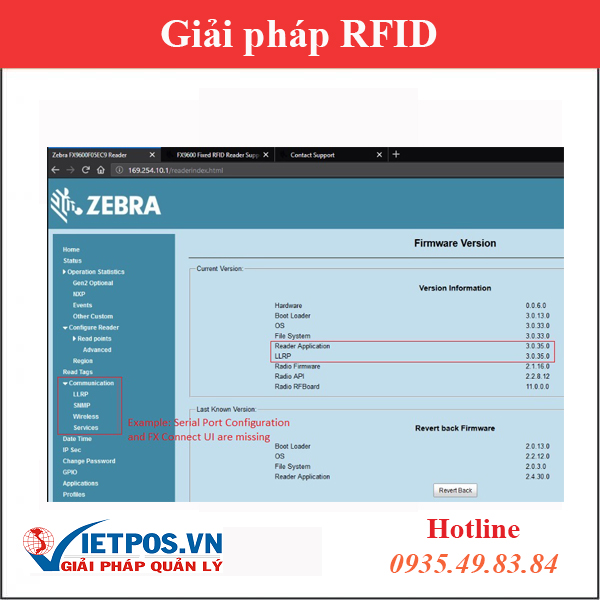
Equipment includes: a fixed reader (such as Zebra FX9600), 2-4 antennas (Zebra AN480/AN720) installed on both sides of the gate, UHF RFID tags attached to containers, and software connecting to the warehouse management system (WMS). When a vehicle passes through the read zone, the reader scans the tags in 0.5-1 second, automatically matching against the registered vehicle list.
Required equipment for an RFID gate
- Fixed UHF reader: Zebra FX9600 or equivalent
- UHF antennas: Zebra AN480, AN720 (2-4 antennas per gate)
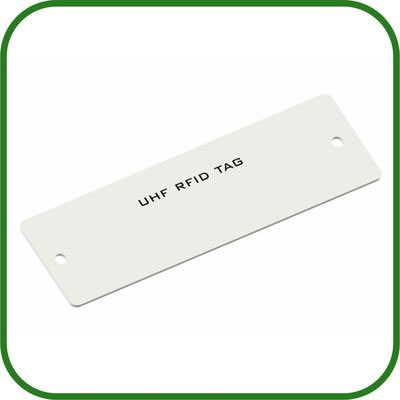
- UHF RFID tags for containers: weather-resistant
- WMS integration software: processes read data and automatic matching
- Indicator light/buzzer: confirms successful read for the driver
Detailed comparison: Manual vs RFID across 5 criteria
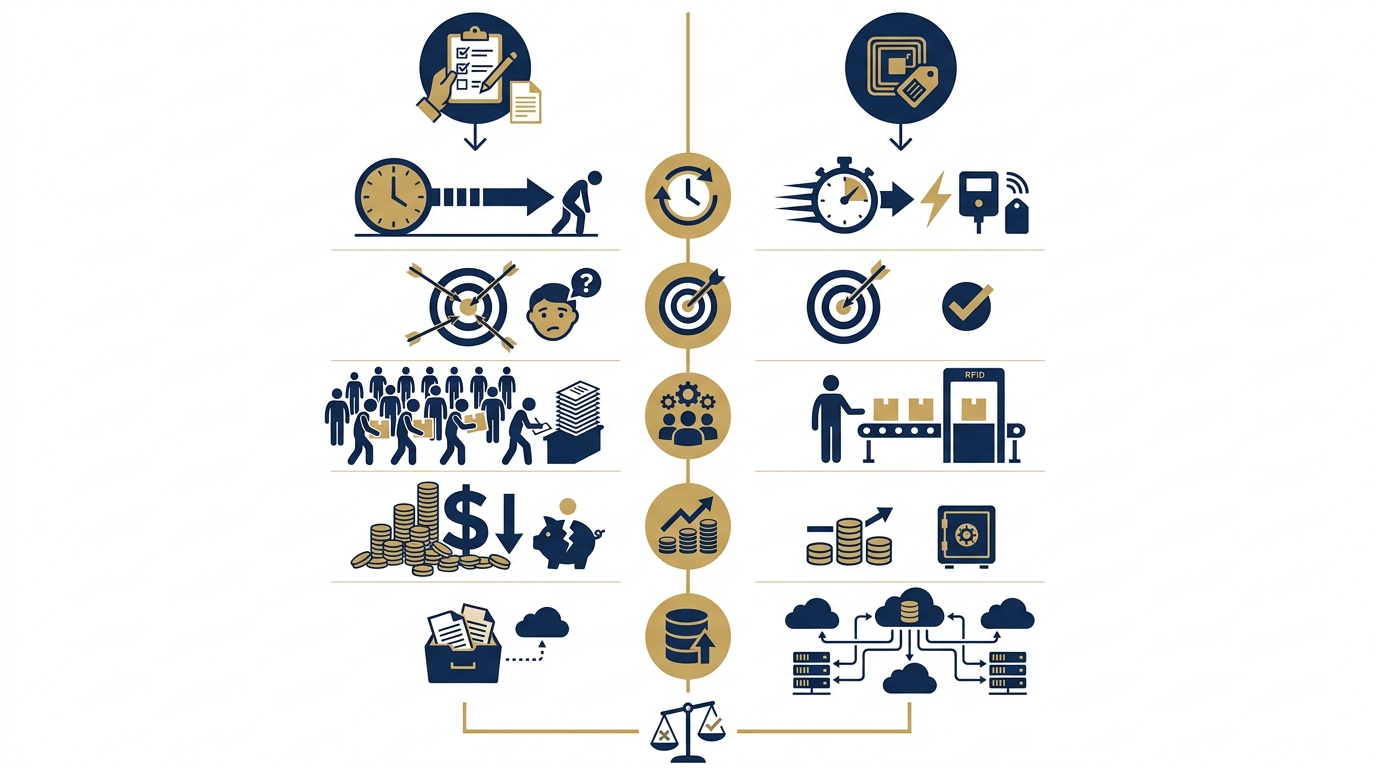
The comparison table below summarizes 5 key criteria: processing time, accuracy, labor, operating cost, and scalability. RFID excels in 4/5 criteria, only losing on initial investment cost.
| Criteria | Manual | RFID Warehouse Gate | Assessment |
|---|---|---|---|
| Time per container | 40-60 minutes | 4-8 minutes | RFID best (8-10x faster) |
| Accuracy | 97-99% (1-3% error) | 99.5-99.9% | RFID best |
| Labor | 4-5 people | 1 supervisor | RFID best (60-80% reduction) |
| Operating cost | Low initially, high long-term | 80-250 million VND investment, long-term savings | Manual cheaper initially |
| Scalability | Increase labor with volume | Add gates, no additional staff | RFID best |
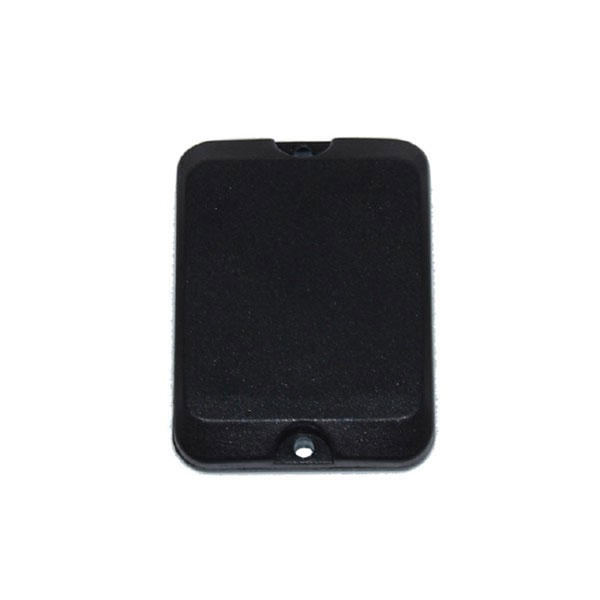
Note: RFID has limitations when attached to metal surfaces or near liquids — radio waves are reflected or absorbed. Specialized tags (such as the VP-T902 On-Metal Passive RFID Tag) and appropriate placement are needed for optimal accuracy.
Which method to choose based on scenarios?
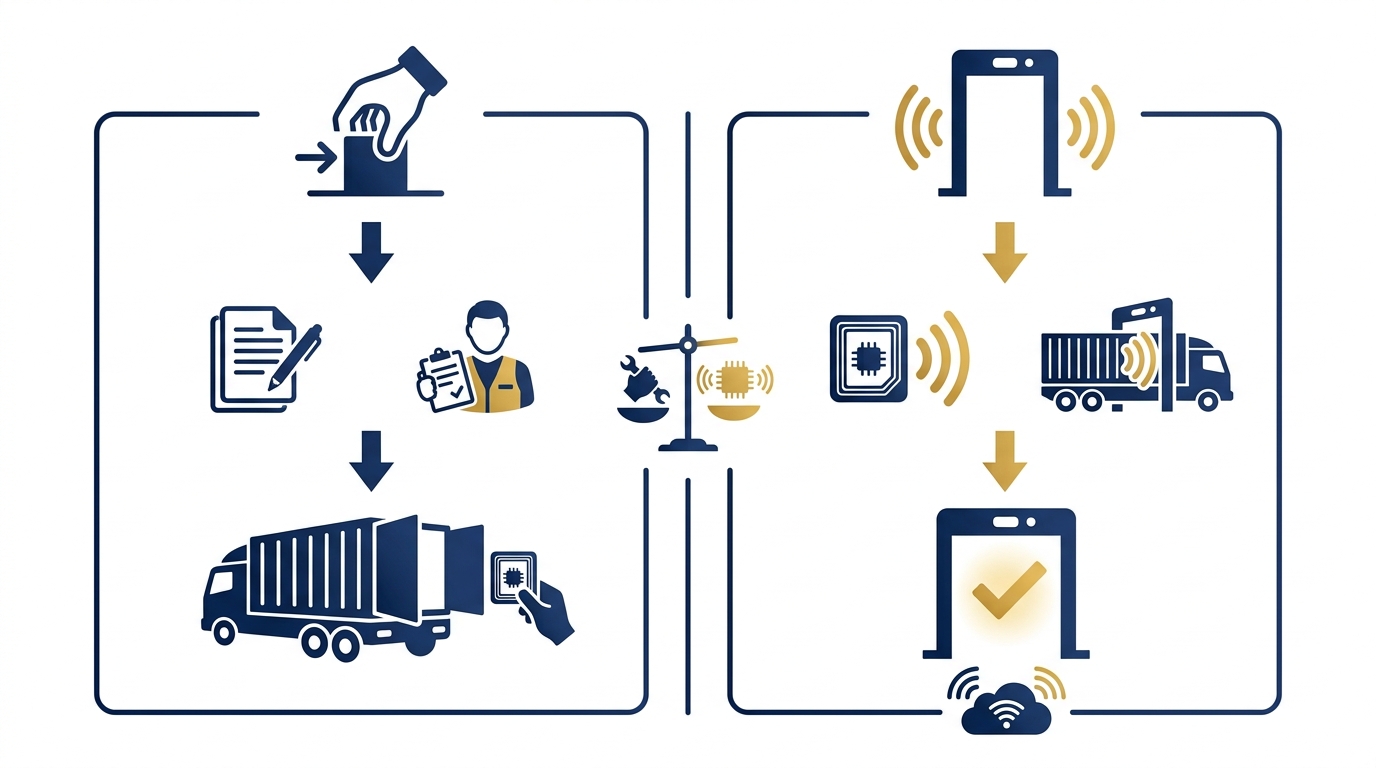
There is no single right solution for every warehouse. The decision depends on the number of containers per day, investment budget, and the operational team's readiness for process change.
Warehouses handling fewer than 5 containers/day: Keep the manual method. The RFID investment cost of 80-250 million VND is hard to justify at this volume. Focus on improving manual processes: standardize forms, use barcode scanners, and train staff to reduce errors.
Warehouses handling 5-20 containers/day: Consider a hybrid approach. Implement RFID for the verification step only, or start with a pilot at one gate. This allows you to measure actual benefits before full deployment.
Warehouses handling over 20 containers/day: RFID is the clear choice. At this volume, manual processing requires 80-100 labor hours/day, equivalent to 10-12 staff. RFID reduces this to 2-3 supervisors, with payback in 12-18 months.
What are the pros and cons of each method?
Manual processing is flexible and requires no initial investment, but is slow, error-prone, and labor-intensive. RFID offers speed, accuracy, and scalability, but requires significant upfront investment and technical expertise.
Manual method
- Pros: No initial investment, flexible with changing processes, easy to train staff, works without power or network.
- Cons: Slow (40-60 minutes/container), 1-3% error rate, requires 4-5 staff, hard to scale, lacks real-time data.
RFID warehouse gate
- Pros: Fast (4-8 minutes/container), 99.5-99.9% accuracy, 1 supervisor, easy to scale, real-time data integration with WMS.
- Cons: High initial investment (80-250 million VND), requires technical expertise, affected by metal/liquid interference, needs tag management.
What is the investment cost for an RFID warehouse gate?
The total cost for a complete RFID gate ranges from 80-250 million VND, depending on the number of antennas, reader model, and software integration. This includes hardware, installation, and basic software setup.
| Component | Cost range (million VND) | Notes |
|---|---|---|
| Fixed UHF reader (Zebra FX9600) | 25-45 | 4-port, Impinj E710 chip |
| UHF antennas (Zebra AN480/AN720) | 8-15 per antenna | 2-4 antennas per gate |
| RFID tags (per tag) | 0.003-0.008 | On-metal tags cost more |
| Software integration | 15-40 | WMS connection, custom development |
| Installation and commissioning | 10-20 | Includes cabling, mounting, testing |
| Total per gate | 80-250 | Depends on configuration |
For warehouses handling over 20 containers/day, the payback period is 12-18 months, considering labor savings of 60-80% and reduced error-related costs.
Which frequency is compliant for RFID warehouse gates in Vietnam?
In Vietnam, the UHF band 918.4–923 MHz is permitted for RFID applications, with a maximum power of 500 mW ERP, according to Circular 08/2021/TT-BTTTT. Imported equipment must have type approval certification.
Key compliance points:
- Frequency range: 918.4–923 MHz
- Maximum transmit power: 500 mW ERP
- Equipment must be type-approved by the Ministry of Information and Communications
- Zebra FX9600 and AN480 antennas support this frequency band
VietPOS provides the equipment infrastructure; enterprises should verify current legal regulations before deployment.
When should you invest in an RFID warehouse gate?
Invest when your warehouse handles over 20 containers/day, when manual errors are causing inventory discrepancies, or when labor costs are rising. A pilot at one gate is a low-risk way to validate benefits.
Signs you need RFID: (1) Processing more than 20 containers/day, (2) Inventory accuracy below 97%, (3) Labor costs exceeding 100 million VND/month for gate operations, (4) Frequent driver waiting times, (5) Difficulty scaling with manual processes.
Signs you can wait: (1) Processing fewer than 5 containers/day, (2) Manual processes are working well with minimal errors, (3) Budget constraints, (4) Team resistance to change.
Step-by-step guide to implementing an RFID warehouse gate
Implementation follows 6 steps: assessment, design, pilot, deployment, training, and optimization. Each step has specific deliverables and timelines.
- Assessment (1-2 weeks): Analyze current process, measure container volume, identify bottlenecks, and define success metrics.
- Design (1-2 weeks): Select equipment, design antenna placement, plan tag placement on containers, and define software integration requirements.
- Pilot (2-4 weeks): Install at one gate, test with 50-100 containers, measure read accuracy and processing time, and adjust settings.
- Deployment (1-2 weeks): Install at all gates, integrate with WMS, and configure user roles and permissions.
- Training (1 week): Train supervisors and staff on system operation, troubleshooting, and exception handling.
- Optimization (ongoing): Monitor performance, analyze data, and refine processes for continuous improvement.
Frequently Asked Questions
Below are answers to common questions about manual vs RFID warehouse gate processing.
How many times faster is an RFID warehouse gate compared to manual processing?
RFID is 8-10 times faster. Manual processing takes 40-60 minutes per container with 4-5 staff, while RFID takes only 4-8 minutes with 1 supervisor. The document verification step — the biggest bottleneck of manual processing (20-30 minutes) — is fully automated by RFID in 1-2 minutes through tag reading and digital data matching.
What is the investment cost for an RFID warehouse gate?
The total cost for one RFID gate ranges from 80-250 million VND, including a fixed reader (Zebra FX9600), 2-4 antennas (Zebra AN480/AN720), UHF RFID tags, WMS integration software, and installation. RFID tags typically cost 3,000-8,000 VND per tag. For warehouses handling over 20 containers/day, the payback period is 12-18 months.
Does RFID work well on metal containers?
Metal reflects radio waves, reducing the effectiveness of standard RFID tags. The solution is to use specialized on-metal tags (such as the VP-T902 On-Metal Passive RFID Tag) or place tags 1-2 cm away from the metal surface using spacers. Tag placement is also important — attach tags in areas less shielded by metal frames.
Which frequency is allowed for RFID in Vietnam?
The UHF band 918.4–923 MHz is permitted for RFID in Vietnam, with a maximum power of 500 mW ERP, according to Circular 08/2021/TT-BTTTT. Imported equipment requires type approval certification. Zebra FX9600 readers and AN480 antennas support this frequency band. VietPOS provides the equipment infrastructure; enterprises should verify current legal regulations before deployment.
Do staff need to confirm before the RFID system records data?
Yes, a staff confirmation step is recommended before data is officially recorded in the system. RFID automatically reads and displays information, but staff should visually check — especially for fragile goods, cold chain items, or when tags are obscured. Standard process: RFID reads → staff confirms → system updates. This reduces risks from damaged or covered tags.
Should a warehouse handling 10 containers/day invest in RFID?
A warehouse handling 10 containers/day can invest partially. At this volume, savings are about 6-8 labor hours/day, equivalent to 1 staff member (10-15 million VND/month). An investment of 80-250 million VND would pay back in 18-24 months. Consider deploying 1 RFID gate, tagging familiar vehicles, and measuring effectiveness for 3-6 months before full expansion.
Cần tư vấn thiết bị/giải pháp cụ thể?
Việt POS phản hồi trong 30 phút · Hotline 4 vùng · Khảo sát miễn phí.
