
Mục lục bài viết (11)
- Sign 1: Inventory discrepancies over 15% after each count
- Sign 2: Technicians spend over 15 minutes each time searching for parts
- Sign 3: Uncontrolled borrowing and returning of parts
- Sign 4: Expired supplies forgotten in the warehouse
- Sign 5: No data to forecast parts demand
- 6-Month ROI Formula for MRO Spare Parts Warehouses
- Comparison Table: Manual Count vs RFID for MRO Warehouses
- Technical Limitations to Know Before Investing in RFID
- Compliant Frequency in Vietnam and the Role of Suppliers
- 6-Month RFID Deployment Roadmap for MRO Warehouses
- FAQ
RFID for MRO (Maintenance, Repair, Operations) spare parts warehouses is a solution that uses radio waves to automatically identify and track maintenance supplies and replacement parts in the warehouse. In Vietnam, this technology is being deployed by factories, manufacturing plants, and maintenance service chains to reduce search time, control inventory, and cut losses.
Investing in RFID for MRO spare parts warehouses is worth considering when inventory discrepancies exceed 15%, search time exceeds 15 minutes per occurrence, or borrowing/returning is out of control. A 6-month ROI is achievable if equipment and deployment costs are under 40% of total annual loss and labor savings.
Table of Contents
- Sign 1: Inventory discrepancies over 15% after each count
- Sign 2: Technicians spend over 15 minutes each time searching for parts
- Sign 3: Uncontrolled borrowing and returning of parts
- Sign 4: Expired supplies forgotten in the warehouse
- Sign 5: No data to forecast parts demand
- 6-Month ROI Formula for MRO Spare Parts Warehouses
- Comparison Table: Manual Count vs RFID for MRO Warehouses
- Technical Limitations to Know Before Investing in RFID
- Compliant Frequency in Vietnam and the Role of Suppliers
- 6-Month RFID Deployment Roadmap for MRO Warehouses
- FAQ
Sign 1: Inventory discrepancies over 15% after each count

If your MRO spare parts warehouse count results frequently deviate 15-30% from records, it's a clear sign the manual system is losing control. RFID enables counting 5-10 times faster than manual barcode scanning, helping detect discrepancies in real time.
Manual counting of MRO spare parts typically takes 2-3 days with a team of 3-5 staff, while using a handheld RFID reader reduces it to 2-4 hours. For a warehouse with 5,000-10,000 SKUs, quarterly counting labor costs can reach 15-25 million VND — a significant figure to include in the ROI calculation.
Sign 2: Technicians spend over 15 minutes each time searching for parts
Related Products



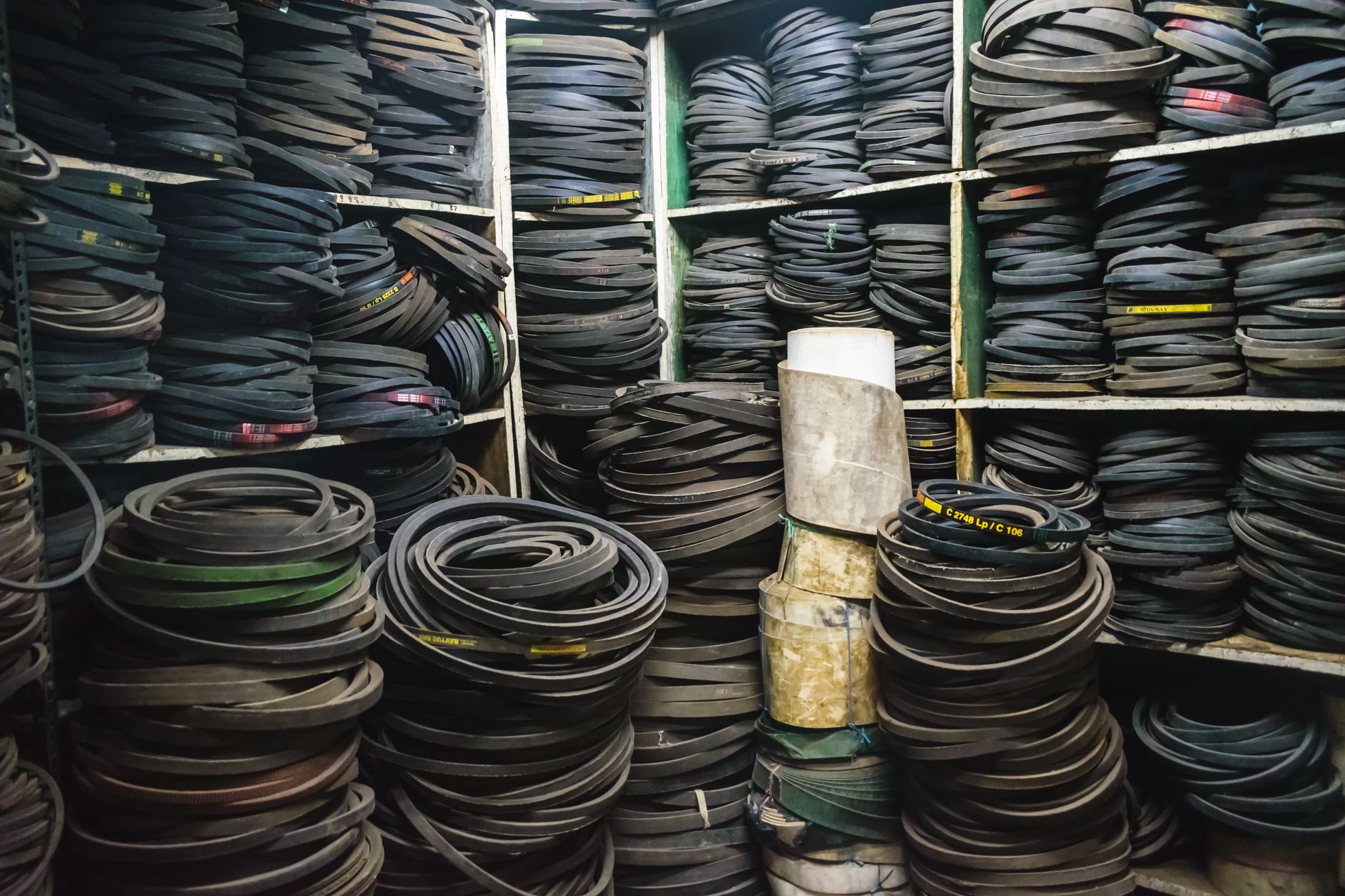
When technicians must stop production equipment for 20-40 minutes just to find a bearing or belt in the warehouse, downtime costs can be 5-10 times the value of that part. RFID locationing helps reduce search time to under 3 minutes.
A factory with 20 maintenance technicians, each searching 3-5 times a day, 15-20 minutes each time — totaling 15-33 labor hours wasted daily. Multiplied by an hourly rate of 50,000-80,000 VND, this equates to 750 million to 2.6 billion VND per year. Deploying RFID locationing helps recover most of this time.
Sign 3: Uncontrolled borrowing and returning of parts

If technicians take parts without updating issue slips, or borrow and "forget" to return them, you are losing money every day. RFID with automatic reading portals records who took what, when, and alerts when items are not returned on time.
Surveys show that 10-20% of MRO parts in warehouses are "borrowed" without proper procedures. For a warehouse valued at 2-5 billion VND, this loss equates to 200 million to 1 billion VND per year. A fixed RFID system combined with management software helps tighten this process.
Sign 4: Expired supplies forgotten in the warehouse
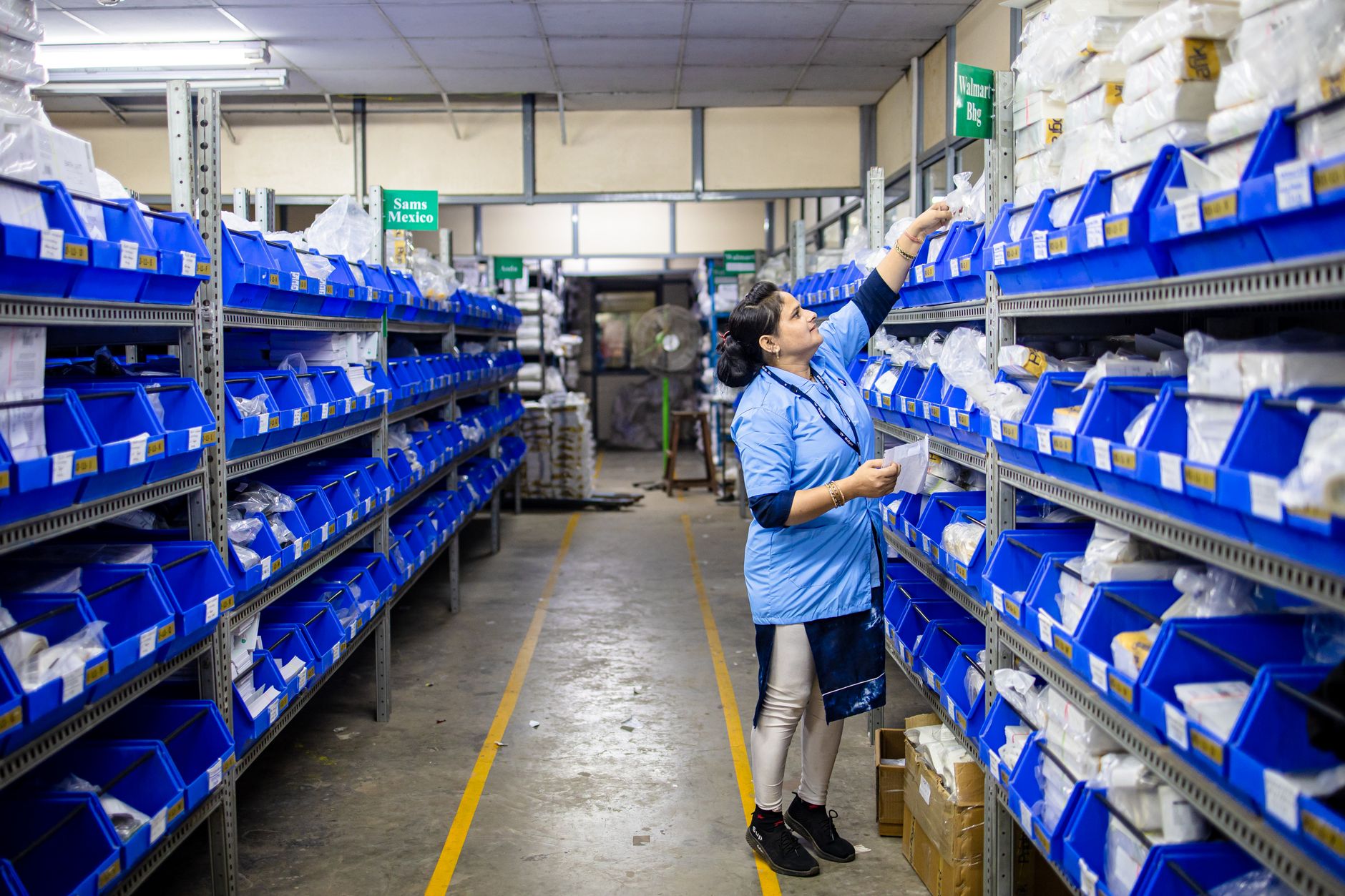
MRO parts such as lubricants, adhesives, and rubber gaskets have expiration dates. Without lot and expiry management, businesses may use degraded materials causing equipment damage. RFID attached to pallets or containers enables automatic expiration tracking.
RFID systems can store production and expiration dates on tags attached to each container. During quick counts with a handheld reader, software automatically lists lots expiring within the next 30-60 days. This reduces the risk of using expired materials — which can cause machine failures worth hundreds of millions of VND.
Sign 5: No data to forecast parts demand
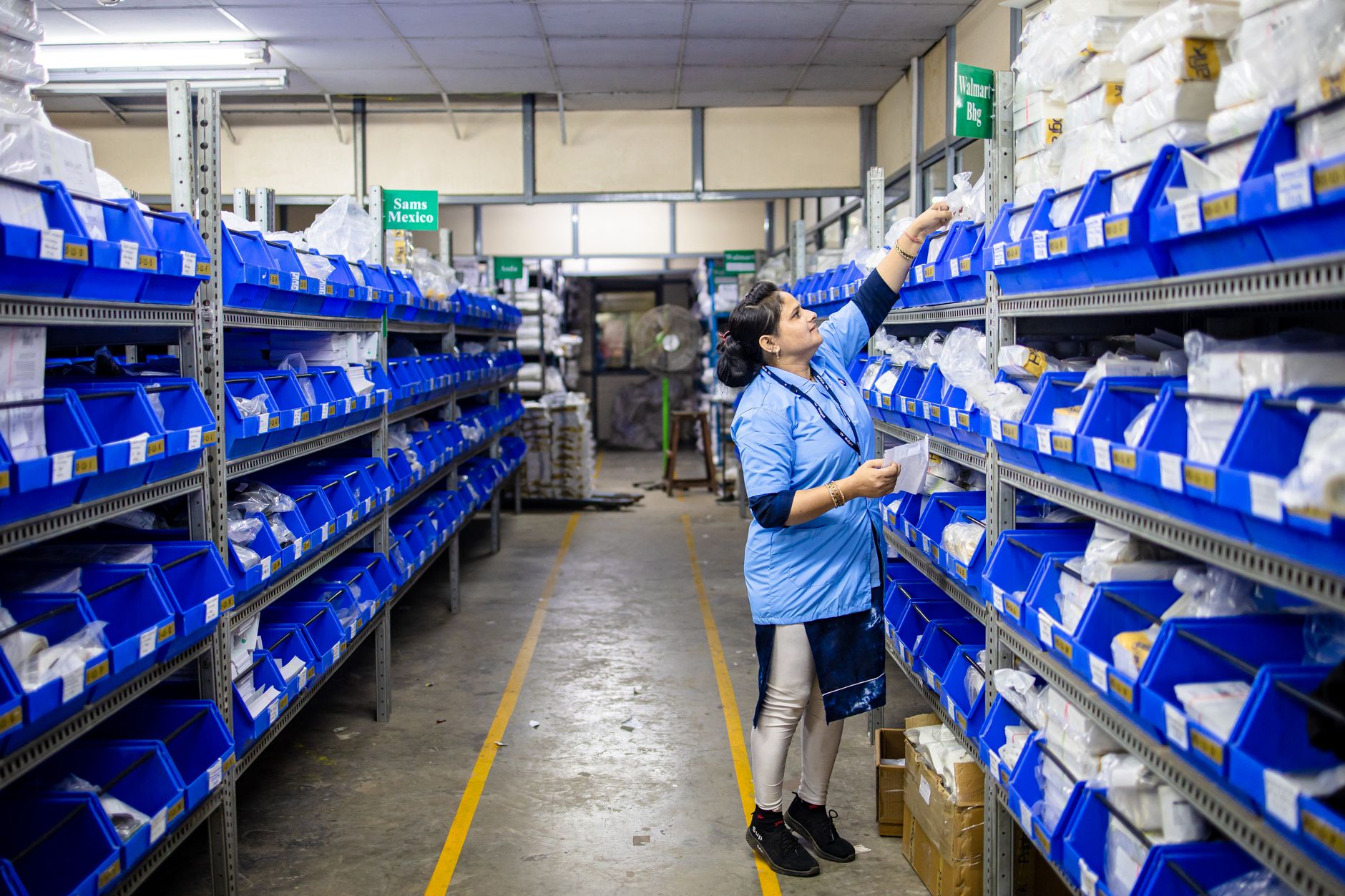
If you don't know which parts are used most, how long they stay in inventory, and monthly usage frequency — you are running the MRO warehouse by intuition. RFID provides actual usage data to optimize inventory.
Data from RFID systems helps build consumption charts over time, identifying safety stock levels, reorder points, and eliminating dead stock. Businesses typically reduce inventory value by 10-20% within 6-12 months thanks to accurate data.
6-Month ROI Formula for MRO Spare Parts Warehouses
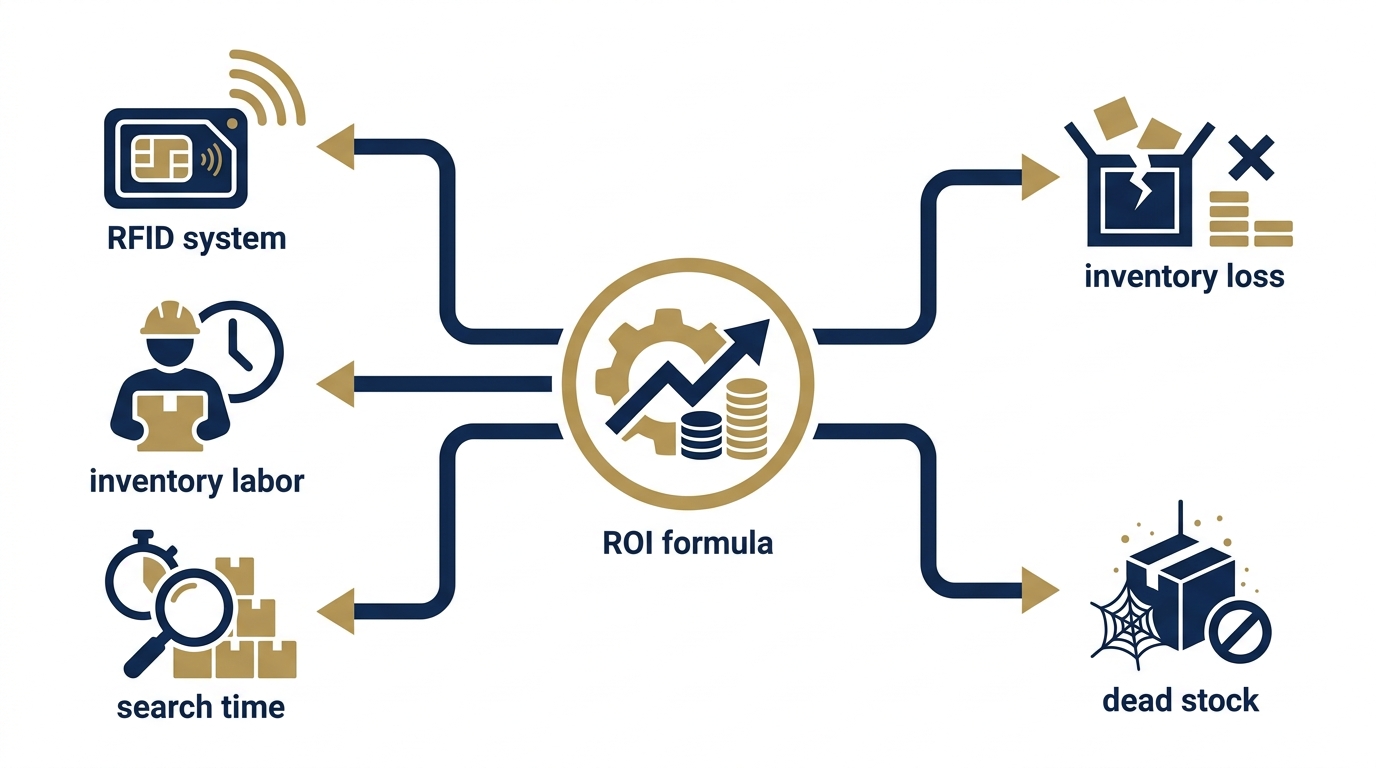
6-Month ROI = (Total Cost Savings – Total Investment Cost) / Total Investment Cost × 100%. Main savings include: counting labor, search time, reduced borrowing/returning losses, and reduced dead stock.
Example: an MRO warehouse with 8,000 SKUs, valued at 3 billion VND. Investment cost for an RFID system (readers, tags, software, deployment) is approximately 200-350 million VND. Estimated annual savings:
- Counting labor: 60-100 million VND/year
- Search time: 150-300 million VND/year (converted from downtime hours)
- Reduced borrowing/returning losses: 100-200 million VND/year
- Reduced dead stock: 100-300 million VND/year (recovered value)
Total savings of 410-900 million VND/year, i.e., 205-450 million VND in 6 months — enough to break even within 6-12 months depending on scale.
Comparison Table: Manual Count vs RFID for MRO Warehouses
The table below directly compares manual methods vs RFID on key operational criteria for MRO spare parts warehouses, helping you assess the differences.
| Criteria | Manual Count | RFID |
|---|---|---|
| Time per full count (5,000-10,000 SKUs) | 2-3 days | 2-4 hours |
| Accuracy rate | 85-92% | 95-99% |
| Labor required per count | 3-5 people | 1-2 people |
| Search time per part | 15-40 minutes | <3 minutes |
| Real-time inventory visibility | No | Yes |
| Expiration tracking | Manual, error-prone | Automatic alerts |
| Borrowing/returning control | Paper-based, unreliable | Automatic logging |
| Data for forecasting | Limited | Comprehensive |
Technical Limitations to Know Before Investing in RFID
RFID is not a magic bullet. UHF waves are affected by metal and liquids, reducing read rates. On-metal tags and proper placement are required for metallic parts. Testing is essential before full deployment.
Key limitations include:
- Metal interference: Use on-metal tags with isolation layers; read rates drop without them.
- Liquid absorption: Liquids absorb UHF signals; avoid placing tags directly on liquid containers.
- Read range: Passive tags typically read 3-10 meters; active tags have longer range but higher cost.
- Tag orientation: Read rates vary with tag orientation relative to reader antenna; multiple antennas may be needed.
- Dense environments: High tag density can cause collisions; use anti-collision protocols.
Compliant Frequency in Vietnam and the Role of Suppliers
In Vietnam, UHF RFID operates at 918.4–923 MHz, compliant with local regulations. Suppliers like Việt POS provide equipment, tags, and integration services to ensure legal and effective deployment.
Việt POS offers a full range of RFID hardware (handheld readers, fixed readers, antennas, tags, printers) and software integration. They also provide consultation on frequency compliance, site surveys, and pilot testing to ensure optimal performance.
6-Month RFID Deployment Roadmap for MRO Warehouses
A structured 6-month roadmap ensures successful RFID deployment: assessment, pilot, scaling, and optimization. Each phase has clear milestones and deliverables.
- Month 1 — Assessment: Analyze current processes, identify pain points, define KPIs, and select pilot area.
- Month 2 — Pilot: Deploy RFID in a small section (e.g., 500-1,000 SKUs), test read rates, and refine workflows.
- Month 3 — Evaluation: Measure pilot results against baseline, calculate preliminary ROI, and adjust strategy.
- Month 4 — Scaling: Expand to full warehouse, install fixed readers at entry/exit points, and tag all items.
- Month 5 — Integration: Integrate RFID data with existing ERP/WMS, train staff, and establish standard operating procedures.
- Month 6 — Optimization: Review performance, fine-tune settings, and plan for continuous improvement.
FAQ
Does RFID work well with metal parts?
Yes, but you need specialized on-metal tags. These tags have an isolation layer that reduces wave reflection from metal surfaces. Read rates reach 95-99% if properly attached. It's recommended to test on 50-100 samples before full deployment.
What is the approximate investment cost for RFID in MRO warehouses?
For a warehouse with 5,000-8,000 SKUs, equipment costs (1-2 handheld readers, 1-2 portal readers, 8,000-15,000 RFID tags) and software range from 150-350 million VND. Deployment and training add 10-20% to the total. Exact figures depend on scale and integration requirements.
What is the average payback period?
For businesses with 2-3 of the pain signs mentioned, payback typically ranges from 6-18 months. If you have 4-5 signs, ROI can be achieved in under 6 months. The deciding factors are downtime costs and current inventory discrepancy value.
Does RFID completely replace barcodes?
Not necessarily. Many businesses run both in parallel: RFID for internal warehouse management, barcodes for transactions with external partners. Modern RFID systems often support reading both barcodes and RFID, allowing flexible transition.
What skills do warehouse staff need to use RFID?
Only 2-3 hours of training is needed: how to use handheld readers, understand portal scanning procedures, and confirm actions in the software. Unlike barcodes requiring per-item scanning, RFID reads in bulk, reducing manual operations by 60-80%.
Can RFID read through carton or plastic boxes?
Yes. UHF waves at 918.4–923 MHz penetrate paper, carton, and dry plastic with read rates of 85-95%. However, liquids and metals attenuate waves. For items packaged with liquids, position tags appropriately or use specialized tags.
Cần tư vấn thiết bị/giải pháp cụ thể?
Việt POS phản hồi trong 30 phút · Hotline 4 vùng · Khảo sát miễn phí.
