
Mục lục bài viết (8)
- Which RFID frequency band is suitable for managing tools, molds, and jigs?
- What are the RFID compliance regulations in Vietnam according to Circular 08/2021?
- What technical considerations are needed for RFID tags mounted on metal?
- What is the certification and compliance testing process for RFID equipment?
- Which international standards relate to UHF RFID and how do they differ from Vietnam?
- Common mistakes when choosing RFID frequency for tools, molds, and jigs
- How to effectively deploy RFID for tools, molds, and jigs in Vietnam?
- FAQ
RFID frequency is the decisive factor in tag read performance in industrial environments, especially when managing tools, molds, and jigs made of metal. In Vietnam, the choice of frequency band must comply with the compliance regulations of the Ministry of Information and Communications, while also matching the physical characteristics of the assets to be managed.
In Vietnam, UHF RFID operates in the 918.4-923 MHz band with power ≤500 mW ERP according to Circular 08/2021. For managing metal tools, molds, and jigs, specialized on-metal RFID tags are required to avoid signal interference. LF/HF are less affected by metal but have short read ranges.
Table of Contents
- Which RFID frequency band is suitable for managing tools, molds, and jigs?
- What are the RFID compliance regulations in Vietnam according to Circular 08/2021?
- What technical considerations are needed for RFID tags mounted on metal?
- What is the certification and compliance testing process for RFID equipment?
- Which international standards relate to UHF RFID and how do they differ from Vietnam?
- Common mistakes when choosing RFID frequency for tools, molds, and jigs
- How to effectively deploy RFID for tools, molds, and jigs in Vietnam?
- FAQ
Which RFID frequency band is suitable for managing tools, molds, and jigs?
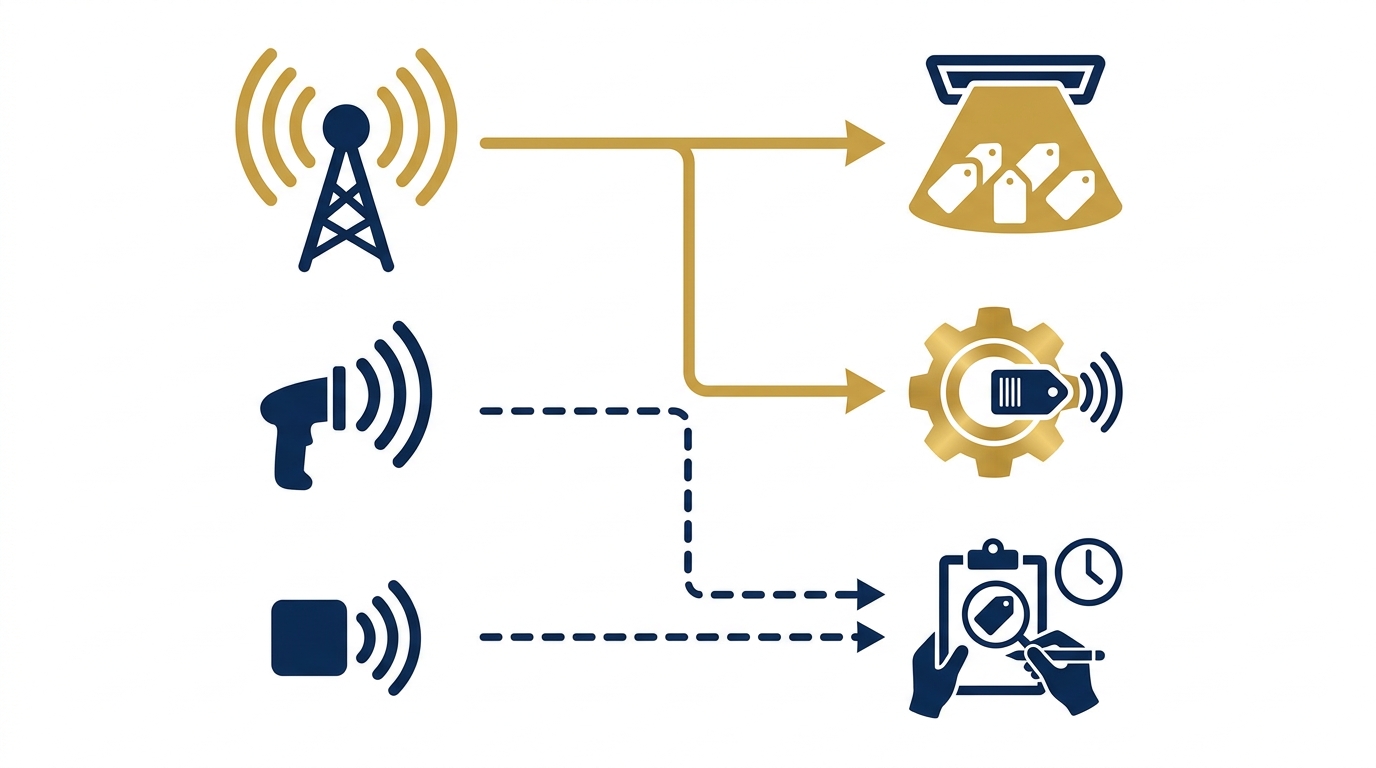
The UHF band (860-960 MHz) is the most optimal choice for managing tools, molds, and jigs thanks to its ability to read multiple tags simultaneously (batch reading) and a long read range of 3-8 meters. However, because metal causes signal interference, specialized on-metal RFID tags are required. The LF (125 kHz) and HF (13.56 MHz) bands are less affected by metal but have short read ranges of only 1-10 cm, suitable for manual one-by-one inventory checks.
In Vietnam, the UHF band is licensed from 918.4 MHz to 923 MHz according to Circular 08/2021/TT-BTTTT, with a maximum transmit power of 500 mW ERP. This is an important legal basis that businesses need to understand when importing and deploying equipment. Meanwhile, the LF and HF bands do not require licensing but are limited in read distance, suitable for on-the-spot identification applications such as tool control at issue counters.
Comparison of pros and cons of each RFID frequency band
- LF (125 kHz): Works well near metal and liquids, low cost, but slow read speed and can only read one tag at a time. Suitable for time attendance, door locks, not optimal for fast inventory.
- HF (13.56 MHz): Balances cost and performance, supports NFC standard, read range 5-10 cm. Suitable for managing small tools when staff bring tags close to the reader.
- UHF (918-923 MHz in Vietnam): Fast reading, multi-tag (200-500 tags/second), read range 3-8 meters. However, sensitive to metal, requires on-metal tags and appropriate power adjustment.
What are the RFID compliance regulations in Vietnam according to Circular 08/2021?
Related Products


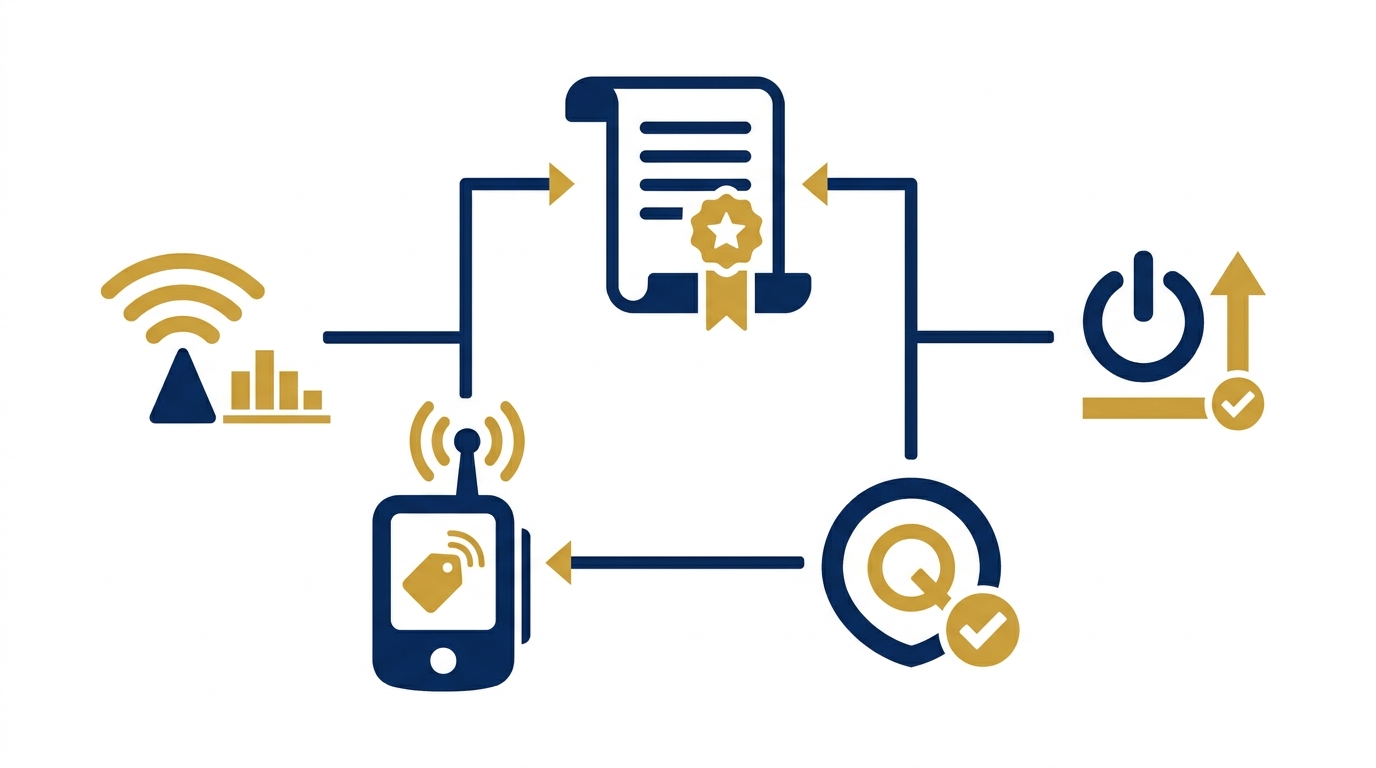
Circular 08/2021/TT-BTTTT stipulates the 918.4-923 MHz band for UHF RFID equipment in Vietnam, with a maximum effective radiated power (ERP) of 500 mW. Equipment must have a compliance certificate according to QCVN 112:2021/BTTTT before being circulated. This regulation is compatible with the European ETSI EN 302 208 standard but differs from the US FCC band (902-928 MHz).
Businesses should note that using UHF equipment outside the designated band or exceeding the permitted power can result in administrative penalties and cause interference to other telecommunications services. When importing UHF RFID readers from abroad, it is necessary to check whether the band configuration supports the 918.4-923 MHz range, as many devices manufactured to the FCC standard will not be fully compatible.
Summary table of RFID frequency band regulations in Vietnam
| Frequency band | Vietnam band | Maximum power | Legal basis |
|---|---|---|---|
| LF | 125 kHz | No specific limit | No license required |
| HF | 13.56 MHz | 42 dBµA/m at 10m | No license required |
| UHF | 918.4-923 MHz | 500 mW ERP | Circular 08/2021/TT-BTTTT |
In addition to frequency regulations, equipment must also meet QCVN 112:2021/BTTTT on electromagnetic compatibility (EMC) and electrical safety. Certification is typically carried out by designated centers such as VNPT, VinaPhone, with a processing time of 5-10 working days. The certification cost for one reader sample ranges from 3-7 million VND, depending on the laboratory and type of equipment.
What technical considerations are needed for RFID tags mounted on metal?
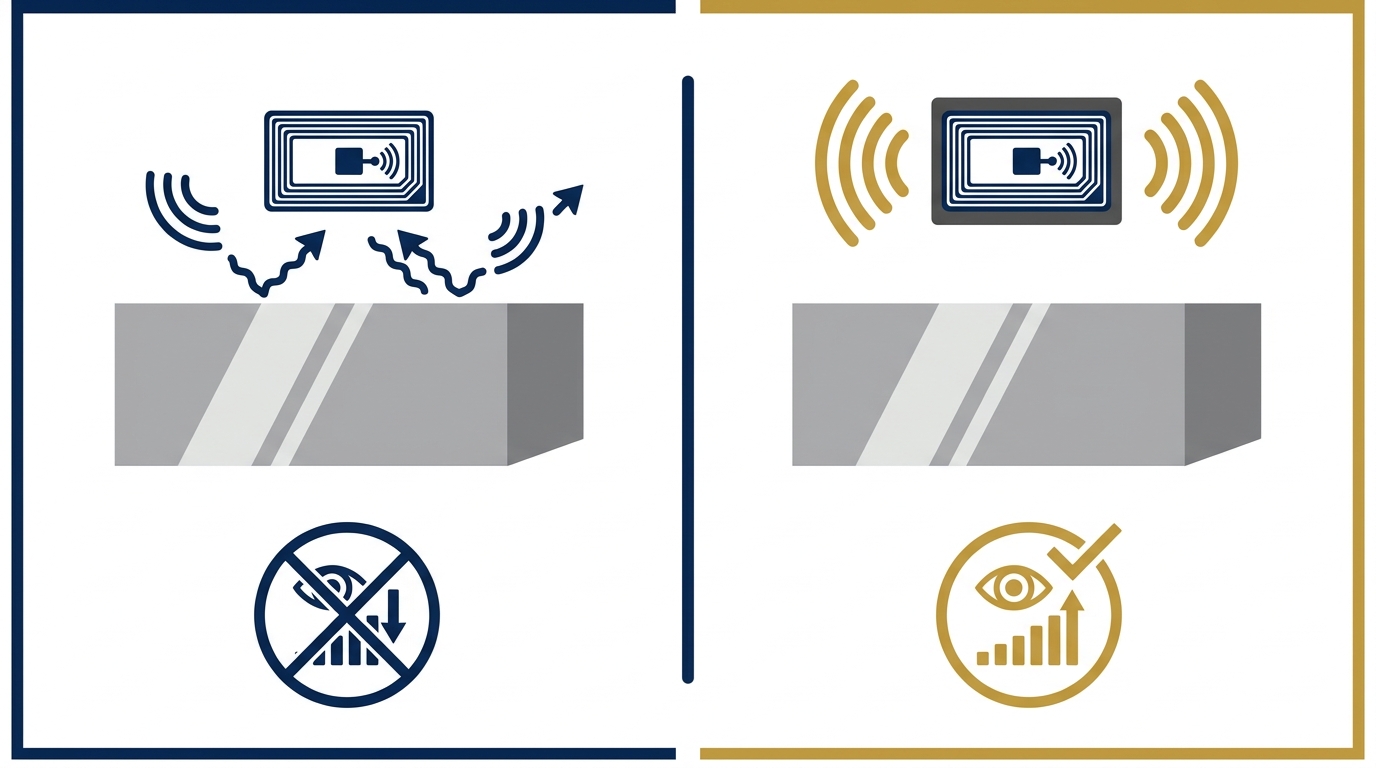
Metal reflects and absorbs electromagnetic waves, causing severe degradation in UHF RFID tag read performance. The solution is to use on-metal (metal-resistant) tags with a ferrite isolation layer or special antenna structure. Otherwise, read rates can drop from 95% to below 50% when mounted directly on steel mold surfaces.
When deploying for tools and molds, businesses need to consider the minimum distance between the tag and the metal surface. With specialized on-metal tags, this distance can be 0-2 mm, while regular tags require 10-15 mm. Additionally, high-temperature environments (plastic injection molds typically operate at 80-150°C) require tags with heat resistance, usually made of PPS plastic or ceramic.
Guide to choosing RFID tags for each asset type
- Hand tools (drills, wrenches, pliers): Use small on-metal tags (8-15 mm diameter), impact-resistant, attached with epoxy adhesive or rivets.
- Plastic injection/casting molds: Choose tags resistant to heat up to 200°C, oil and grease resistant, mounted in positions that do not come into direct contact with molten plastic.
- Jigs/fixtures: Prioritize larger tags (30-50 mm) to increase the read area, mounted in positions easily accessible for handheld readers.
- Measuring tools (calipers, micrometers): Use ultra-thin tags (thickness <1 mm) to not affect operation, can be attached with industrial adhesive tape.
Việt POS provides the VP-T902 on-metal passive RFID tag and VP-RI942 passive RFID tag lines specifically designed for industrial environments, helping businesses optimize read rates when mounted on metal surfaces.
What is the certification and compliance testing process for RFID equipment?

The compliance certification process for RFID equipment in Vietnam consists of 4 steps: preparing technical documentation, submitting samples to a designated laboratory, conducting tests according to QCVN, and issuing the certificate of conformity. The entire process typically takes 10-20 working days, depending on the laboratory's schedule and the complexity of the equipment.
Businesses need to prepare a complete set of documents including technical specifications, user manual, and declaration of conformity from the manufacturer. After receiving the certificate, the equipment must be labeled with the conformity mark before being circulated on the market. For imported equipment, the importer is responsible for carrying out this procedure.
Detailed steps in the compliance certification process
- Step 1 - Prepare documentation: Gather technical specifications, user manual, manufacturer's declaration, and import documents.
- Step 2 - Submit samples: Send equipment samples to a designated laboratory (e.g., VNPT, VinaPhone) for testing.
- Step 3 - Conduct testing: The laboratory performs tests according to QCVN 112:2021/BTTTT, including frequency, power, EMC, and safety checks.
- Step 4 - Issue certificate: After passing all tests, the certification body issues the certificate of conformity, valid for 3 years.
Việt POS supports customers in checking the compliance status of equipment before purchase and provides documentation related to the certification of the products we supply.
Which international standards relate to UHF RFID and how do they differ from Vietnam?

The main international standards for UHF RFID are ETSI EN 302 208 (Europe, 865-868 MHz) and FCC Part 15 (USA, 902-928 MHz). Vietnam's regulation (918.4-923 MHz) is closer to the FCC band but not identical. This difference affects device compatibility: equipment configured for the European band will not work in Vietnam, while some FCC devices can be reconfigured.
When selecting equipment, businesses should request the supplier to confirm the band configuration and compliance certificate suitable for the Vietnamese market. Using non-compliant equipment not only risks legal penalties but also causes operational instability due to interference from other devices operating in the same band.
Comparison table of UHF RFID standards by region
| Region | Standard | Frequency band | Max power | Compatibility with Vietnam |
|---|---|---|---|---|
| Europe | ETSI EN 302 208 | 865-868 MHz | 2 W ERP | Not compatible |
| USA | FCC Part 15 | 902-928 MHz | 4 W EIRP | Partially compatible (requires reconfiguration) |
| Vietnam | Circular 08/2021 | 918.4-923 MHz | 500 mW ERP | Fully compatible |
In addition, the ISO/IEC 18000-63 standard defines the air interface protocol for UHF RFID, ensuring interoperability between tags and readers from different manufacturers. This standard is applied globally and is not affected by regional frequency regulations.
Common mistakes when choosing RFID frequency for tools, molds, and jigs
- Choosing UHF without on-metal tags: Leads to read rates dropping below 50% when mounted on metal surfaces.
- Ignoring compliance regulations: Importing equipment configured for the FCC band without checking compatibility with Vietnam's 918.4-923 MHz band.
- Not considering the operating environment: Using standard tags in high-temperature or chemical environments, causing rapid degradation.
- Overlooking read range requirements: Choosing LF/HF when a long read range is needed for warehouse inventory, or choosing UHF when only short-range identification is needed.
These mistakes not only waste investment costs but also cause operational disruptions. For example, a manufacturing enterprise that chose UHF readers without on-metal tags had to replace all tags after 3 months because the read rate was only 40%, directly affecting the tool issuance process.
How to avoid common mistakes
- Conduct a pilot test: Before large-scale deployment, test with a small batch of tags on actual assets to evaluate read rates and durability.
- Consult with experts: Work with suppliers like Việt POS who have experience in industrial RFID deployment to select the right frequency and tag type.
- Check compliance documents: Ensure all equipment has a certificate of conformity according to QCVN 112:2021/BTTTT and is configured for the Vietnamese band.
How to effectively deploy RFID for tools, molds, and jigs in Vietnam?
- Assess needs and environment: Identify the types of assets, operating environment (temperature, chemicals, impact), and required read range.
- Choose the frequency band: Based on the assessment, select UHF for long-range batch reading or LF/HF for short-range identification.
- Select appropriate tags: Use on-metal tags for metal assets, heat-resistant tags for high-temperature environments.
- Deploy readers and infrastructure: Install fixed readers at checkpoints or use handheld readers for flexible inventory.
- Integrate with management software: Connect RFID data to the ERP or tool management system for automatic tracking.
- Test and optimize: Conduct pilot runs, adjust reader power and tag placement to achieve optimal read rates.
Việt POS provides comprehensive solutions from consulting, equipment supply (readers, tags, antennas) to deployment support. Our team has experience in implementing RFID systems for manufacturing enterprises in Vietnam, helping customers avoid common pitfalls and optimize return on investment.
Need a detailed consultation?
Contact Việt POS today for advice on choosing the right RFID frequency and equipment for your business.
Contact nowFAQ
What is the UHF RFID frequency band allowed in Vietnam?
The UHF RFID frequency band allowed in Vietnam is 918.4-923 MHz according to Circular 08/2021/TT-BTTTT, with a maximum effective radiated power (ERP) of 500 mW. Businesses need to ensure imported equipment is configured for this band and has a compliance certificate according to QCVN 112:2021/BTTTT before use.
Can regular RFID tags be read when mounted on metal surfaces?
Regular UHF RFID tags will experience severe performance degradation when mounted directly on metal surfaces, with read rates potentially dropping below 50%. The cause is that metal reflects and absorbs electromagnetic waves. The solution is to use on-metal (metal-resistant) RFID tags with a ferrite isolation layer or special antenna structure, allowing direct mounting with a distance of 0-2 mm.
How do LF, HF, and UHF frequency bands differ in tool management applications?
LF (125 kHz) and HF (13.56 MHz) have short read ranges (1-10 cm), are less affected by metal, and are suitable for control at tool issue counters. UHF (918-923 MHz) has a long read range (3-8 meters), can read multiple tags simultaneously, and is optimal for fast warehouse inventory but requires on-metal tags when mounted on metal. The choice depends on the specific scale and operational process.
What is the cost of compliance certification for RFID equipment in Vietnam?
The cost of compliance certification for one UHF RFID reader sample in Vietnam ranges from 3-7 million VND, depending on the designated laboratory and test items. The certification process typically takes 10-20 working days. This budget does not include consulting fees and technical documentation preparation.
Can RFID equipment imported from the US be used in Vietnam?
UHF RFID equipment manufactured to the FCC standard (USA) uses the 902-928 MHz band, which is not fully compatible with the legal band in Vietnam (918.4-923 MHz). Some devices can be reconfigured, but technical verification and new compliance certification are required. Businesses should ask suppliers to confirm the band configuration before importing.
Can RFID completely replace manual tool inventory?
RFID automates the identification and recording process, reducing inventory time from hours to minutes. However, staff still need to verify results before updating the system, especially when discrepancies are detected. RFID is a supporting tool, not a complete replacement for a company's internal control processes.
Cần tư vấn thiết bị/giải pháp cụ thể?
Việt POS phản hồi trong 30 phút · Hotline 4 vùng · Khảo sát miễn phí.
