Mục lục bài viết (7)
- How are AI smart glasses and traditional smart glasses different?
- Detailed comparison: AI smart glasses vs Traditional smart glasses
- Real-world applications for businesses: What can AI smart glasses do?
- Who are traditional smart glasses suitable for?
- Investment cost and ROI for small and medium enterprises
- Trend 2026: Are AI smart glasses replacing traditional smart glasses?
- Frequently asked questions
AI smart glasses and traditional smart glasses both belong to the wearable device category, but the core difference lies in data processing capability. AI smart glasses integrate virtual assistants (GPT, Gemini), enabling translation, object recognition, and voice-based information lookup without needing a phone. Traditional smart glasses (AR) only display content from a source device. This article provides a detailed comparison of the two product lines, helping Vietnamese business owners choose the right tool for operations, export, and management.
How are AI smart glasses and traditional smart glasses different?
AI smart glasses have their own processing chip, independent internet connectivity, and run large language models for voice interaction, real-time translation, and object recognition. Traditional smart glasses (often called AR glasses) are merely wearable displays that need to connect to a phone/computer to show content — they have no independent AI processing capability.
The core difference: AI smart glasses are independent computing devices, while traditional smart glasses are dependent display devices. For businesses, this determines work efficiency: a warehouse worker can ask "where is package A?" and receive an answer directly on the glasses, whereas AR glasses only display pre-programmed data from the warehouse management system.
Detailed comparison: AI smart glasses vs Traditional smart glasses
The table below compares 5 main criteria: processing capability, connectivity, interaction, enterprise applications, and investment cost. Data is based on product lines available on the market in 2025-2026.
Bạn đang tìm sản phẩm cho chủ đề này?
Việt POS phân phối chính hãng — bảo hành 24-36 tháng, hỗ trợ kỹ thuật 24/7.
| Criteria | AI smart glasses (e.g., Rokid Glasses Style) | Traditional smart glasses (e.g., Rokid Max) |
|---|---|---|
| AI processing | Has dedicated AI chip, runs GPT/Gemini, processes voice and images in real-time | No, only displays signals from external sources |
| Connectivity | Independent WiFi/Bluetooth, no phone required | Requires USB-C/HDMI connection to phone, laptop |
| Interaction | Voice, touch, hand gestures | Control from source device (mouse, touchpad) |
| Real-time translation | Yes, supports 50+ languages, displays subtitles on glasses | No such capability |
| Investment cost (reference) | 8-15 million VND | 6-12 million VND |
Real-world applications for businesses: What can AI smart glasses do?
For Vietnamese enterprises, AI smart glasses unlock 3 main application groups: (1) supporting foreign language communication for export teams, (2) paperless product information lookup in warehouses, and (3) voice-guided production procedures for new workers.
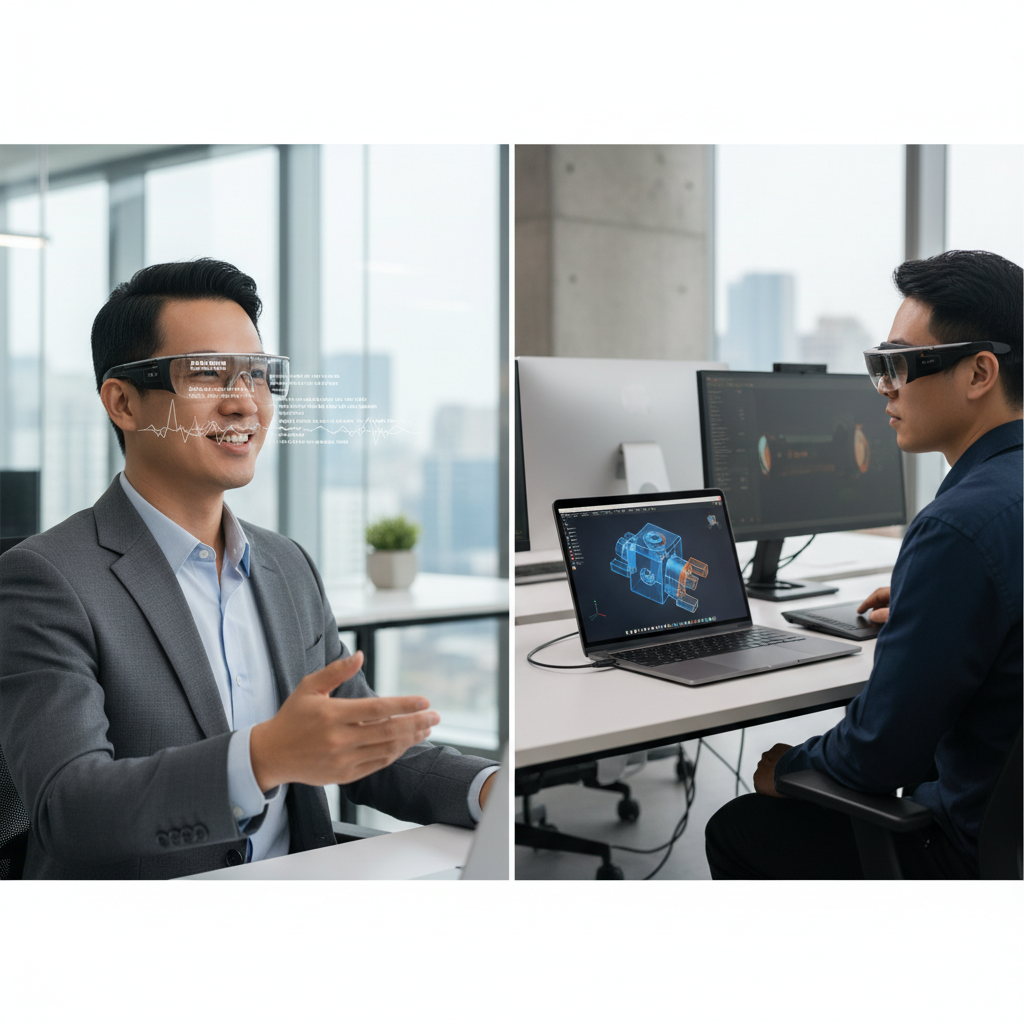
Example: An export sales staff at a footwear company in Ho Chi Minh City wears Rokid Glasses Style during a meeting with Japanese partners. The glasses automatically translate and display Vietnamese subtitles in real-time, enabling a smooth meeting without an interpreter. A one-time investment of 10-12 million VND versus hiring an interpreter for 500-1000 USD/day.
Who are traditional smart glasses suitable for?
Traditional smart glasses (AR) are suitable for businesses needing visual data display: viewing 3D technical drawings, assembly instructions, document presentations in meetings — where content is pre-prepared and does not require real-time AI processing.
Example: A manufacturing engineer wears Rokid Max, connects to a laptop, and views a 3D CAD drawing of a POS machine component directly in real space. They zoom in and rotate details using a handheld controller. This is a strong use case for manufacturing, assembly, and equipment maintenance industries.
Investment cost and ROI for small and medium enterprises
Investing in AI smart glasses for a team of 3-5 people costs approximately 30-75 million VND. ROI comes from time savings in lookup, reduced communication errors, and 15-25% productivity gains in repetitive tasks. Traditional smart glasses cost 20-30% less but are limited to display tasks.
For a retail business with a 200-500m² warehouse, investing in 2 AI glasses for warehouse staff reduces item search time from 15-20 minutes per instance to 3-5 minutes per instance. With 30-50 search instances per day, this saves 6-10 labor hours per day — ROI under 6 months.
Trend 2026: Are AI smart glasses replacing traditional smart glasses?
According to IDC 2025 report, the AI Glasses market grew 280% YoY, while traditional AR Glasses grew only 45%. The reason: AI Glasses better solve communication and information lookup problems — core business needs — compared to mere content display.
However, traditional smart glasses still hold a role in industries requiring high-resolution graphics display: design, healthcare, education. Businesses should clearly identify their needs: if they need smart interaction, choose AI smart glasses. If they need a portable display, choose AR glasses.
Frequently asked questions
Can AI smart glasses translate Chinese, Japanese, and Korean?
Yes. Rokid Glasses Style supports real-time translation for over 50 languages, including Chinese, Japanese, Korean, English, and French. Results are displayed as subtitles on the glasses with a latency of under 1-2 seconds. Suitable for export, tourism, and international negotiation businesses.
Can traditional smart glasses run AI applications?
Not directly. Smart glasses are only display screens. To use AI, you need to connect them to a phone or laptop with AI applications installed, and the results are displayed through the glasses. However, the experience is not as seamless as dedicated AI smart glasses.
What is the cost of investing in AI smart glasses for a team of 5?
Approximately 40-75 million VND depending on the model. Rokid Glasses Style reference price is 8-12 million VND per unit. Việt POS is an authorized distributor with a 12-month warranty. Contact the hotline for wholesale pricing for bulk orders.
Do AI smart glasses require a 3G/4G SIM card?
Not mandatory. AI smart glasses connect via WiFi or Bluetooth to a phone for internet access. Some models have an eSIM slot. In Vietnam, WiFi connectivity is the most common and stable for AI features.
Can traditional smart glasses be used for watching movies and playing games?
Yes. AR glasses like Rokid Max provide a 200-300 inch virtual screen experience, connecting to phones, laptops, and Nintendo Switch. Suitable for personal entertainment or product demos for customers.
Need advice on choosing AI smart glasses or smart glasses suitable for your industry? Call now 0935 498 384 — Việt POS is an authorized Rokid distributor, with a 12-month warranty and on-site demo support in Ho Chi Minh City and Hanoi.
Cần tư vấn thiết bị/giải pháp cụ thể?
Việt POS phản hồi trong 30 phút · Hotline 4 vùng · Khảo sát miễn phí.
Bài viết cùng chủ đề